
Why Tech Billionaires Shield Their Kids from Technology
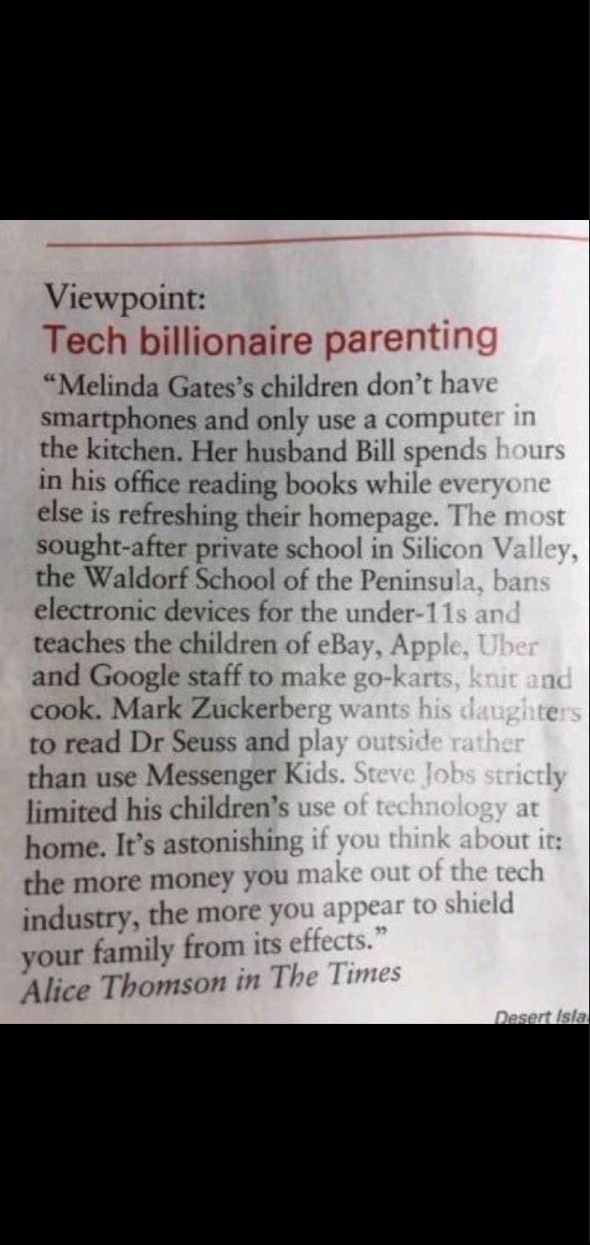
The image is almost cinematic: the architect of an addictive social platform turns off the Wi‑Fi in his own home, the venture capitalist who financed a data‑driven company enrolls his children in a school with no screens, the billionaire investor who made a fortune on surveillance software keeps family life analog. That contradiction—builders of the attention economy insulating their children from it—has become a defining and often controversial pattern of modern billionaire parenting. It provokes obvious questions: are these choices a form of enlightened restraint, a kind of maternal‑paternal guilt, a status symbol, or a blunt admission that technology has harms the architects prefer not to expose their own offspring to?
tech billionaires parenting
THE PATTERN AND THE PEOPLE
The pattern is simple and striking: influential figures in the tech world who shape the platforms millions use frequently place strict limits on those same technologies inside their homes. News accounts and longform profiles over the past decade highlight recurring anecdotes—founders who limit device use, investors who send children to schools designed intentionally without screens, families that delay granting smartphones until the teens. These are not isolated tales of eccentric households; together they reveal a set of beliefs about childhood, risk, and the rhythm of family life.

screen-free schools
The contradiction speaks louder than any apology: when designers of addictive systems avoid them for their kids, it forces a broader conversation about design responsibility and inequality.

Silicon Valley parents
WHY THEY DO IT
Protecting Development and Attention
One of the clearest justifications given by parents—tech elite and otherwise—is the impact of screens on attention, sleep, and social development. Pediatric research, public health guidance, and mainstream parenting advice underline that early, unregulated exposure to screens can affect sleep patterns, reduce unstructured play, and make sustained attention more difficult. For parents who built products that optimize engagement using psychological levers, the choice to limit exposure at home can be framed as an earnest application of that evidence to their children’s benefit.

device-free childhood
A Moral Reckoning or Quiet Hypocrisy?
Another reading is moral. Some technologists express regret about how their creations are used. Limiting family access becomes a private corrective: a way to say, intentionally or implicitly, that certain design choices were mistakes or at least misapplied. Critics, however, call this out as hypocrisy—arguing that if the harms are real, leaders should do more than shelter their children; they should reshape their products, fund remediation, or accept responsibility publicly rather than turn the problem into a private family rule.

tech elite family rules
Status and Cultural Signaling
There is also a signal in the practice. In affluent circles, being able to choose a device‑free childhood is itself a luxury: you can afford schools without screens, tutors who provide enrichment offline, and domestic support that enforces rules. For this reason, some sociologists and cultural critics view tech‑free parenting among the wealthy as a new form of elite distinction—another marker that separates the children of the powerful from the general population.
digital detox for kids
HOW THEY PRACTICE IT
School Choices and Alternative Education
One of the most consequential choices for affluent parents is where children spend their weekday hours. Families with resources often opt for private or boutique schools that minimize device use, emphasize classical or experiential curricula, or simply enforce a tech‑light philosophy. These environments promise extended time for face‑to‑face learning, play, and mentorship—things proponents say digital classrooms struggle to reproduce.

privileged tech parenting
Household Rules and Routines
At home the policies tend to be blunt and consistent: no screens at the table, device curfews, no social media accounts until a certain age, phones stored outside bedrooms at night. Enforcement is baked into routines—family game nights, outdoor time, and structured homework sessions become alternatives to passive scrolling. Wealth amplifies enforcement: nannies, tutors, and house rules backed by staff create an infrastructure that most families cannot replicate.

tech billionaires kids screen time
Limiting Platforms, Not Skills
Importantly, many of these families don’t reject technology wholesale. Rather, they choose controlled and purposeful exposures: supervised coding classes, guided apps that teach math or languages, and curated multimedia for creativity. The distinction is between passive engagement and active skill development. The aim is digital literacy on their own terms—students learn to code and understand algorithms but often under adult supervision and in contexts designed by educators rather than by product designers chasing engagement metrics.
THE SOCIAL CONSEQUENCES
Inequality and the Digital Divide
The practices of tech billionaires do more than protect their children; they spotlight inequality. When privilege permits an offline childhood that others cannot afford, the result is a widening experiential gap: children who grow up in tech‑rich but attention‑protected environments gain advantages in focus, unstructured creativity, and family stability. Meanwhile, children in less resourced homes may rely on screens for childcare, homework help, or social connection—conditions that can intensify existing disparities.
Policy and Public Trust
There is a policy dimension as well. If industry leaders acknowledge product harms privately but resist regulation publicly, that gap corrodes trust. Conversely, if elite families’ choices drive public attention to potential harms, they can catalyze policy conversations—about age limits for social media, design standards to reduce addiction, or school investments that provide tech‑free enrichment for all children.
When the wealthy privatize solutions to public problems, society faces a choice: replicate those solutions broadly or accept a deeper class divide.
CRITIQUES AND COUNTERARGUMENTS
Does Limiting Exposure Hamper Readiness?
A common critique is that sheltering children from mainstream platforms risks leaving them socially or professionally disadvantaged. In a world where digital fluency is a prerequisite for many careers, delayed or minimal engagement with technology can be a liability. Tech‑sparing households attempt to remedy this with targeted skill building, but critics argue controlled exposure might not reproduce the spontaneous digital skills kids develop when allowed to tinker freely online.
Are These Choices Scalable?
Another critique centers on scalability. Wealth can buy alternative schools, safe parks, and staff who enforce rules—resources unavailable to many. Public policy could help by funding enrichment programs, supporting evidence‑based screen guidance, and creating community spaces for play. But those require political will and money; without them, family‑level solutions remain unequal in reach.
WHAT PARENTS AND POLITICIANS CAN TAKE FROM THIS
Practical Lessons for Everyday Families
Not every parent needs private tutors or a device‑free private school to apply the core idea: intention matters. A few practical, scalable steps follow:
- Set predictable routines: regular device‑free meals and technology curfews help normalize boundaries.
- Prioritize active use: favor apps and activities that teach creation over passive consumption.
- Model behavior: parents who reduce their own screen time send powerful social cues.
- Supervised early learning: guided digital activities can build skills without replicating the open‑ended risks of social feeds.
Policy Moves That Could Narrow the Gap
Policymakers who see this as a social problem can act in ways that don't require dismantling industry overnight. Investments in after‑school programs, funding for device‑free community learning centers, enforcement of child privacy protections, and educational standards that teach digital citizenship are practical interventions that replicate some benefits of wealthy parents' choices at scale.
CONCLUSION: PRIVILEGE, RESPONSIBILITY, AND THE FUTURE
The sight of tech billionaires shielding their children from technology crystallizes a set of tensions that define the digital age: innovation and regret, private solutions and public consequences, skill formation and exposure to harm. Whether one reads these practices as enlightened parenting or elite hypocrisy depends in part on whether public policy and corporate responsibility keep pace with the challenges posed by persuasive technologies.
At its best, the pattern has something valuable to teach: that technology is neither inevitably good nor irredeemably bad, and that design choices matter enormously for children’s daily lives. At its worst, it risks converting a response to a public challenge into a private luxury—one that widens inequalities and lets designers off the hook.
- Some tech leaders limit their children’s device use for developmental and moral reasons, but these choices are enabled by privilege.
- Controlled, purposeful exposure—supervised coding, curated learning—can teach digital skills while minimizing harm.
- Public investments in education, child privacy, and enrichment programs are necessary to make these benefits widely available.
A balanced approach recognizes both the power of digital tools and the value of protecting childhood from relentless attention economics.