Why Oracle’s Mass Email Layoffs Reveal a Tech Reset

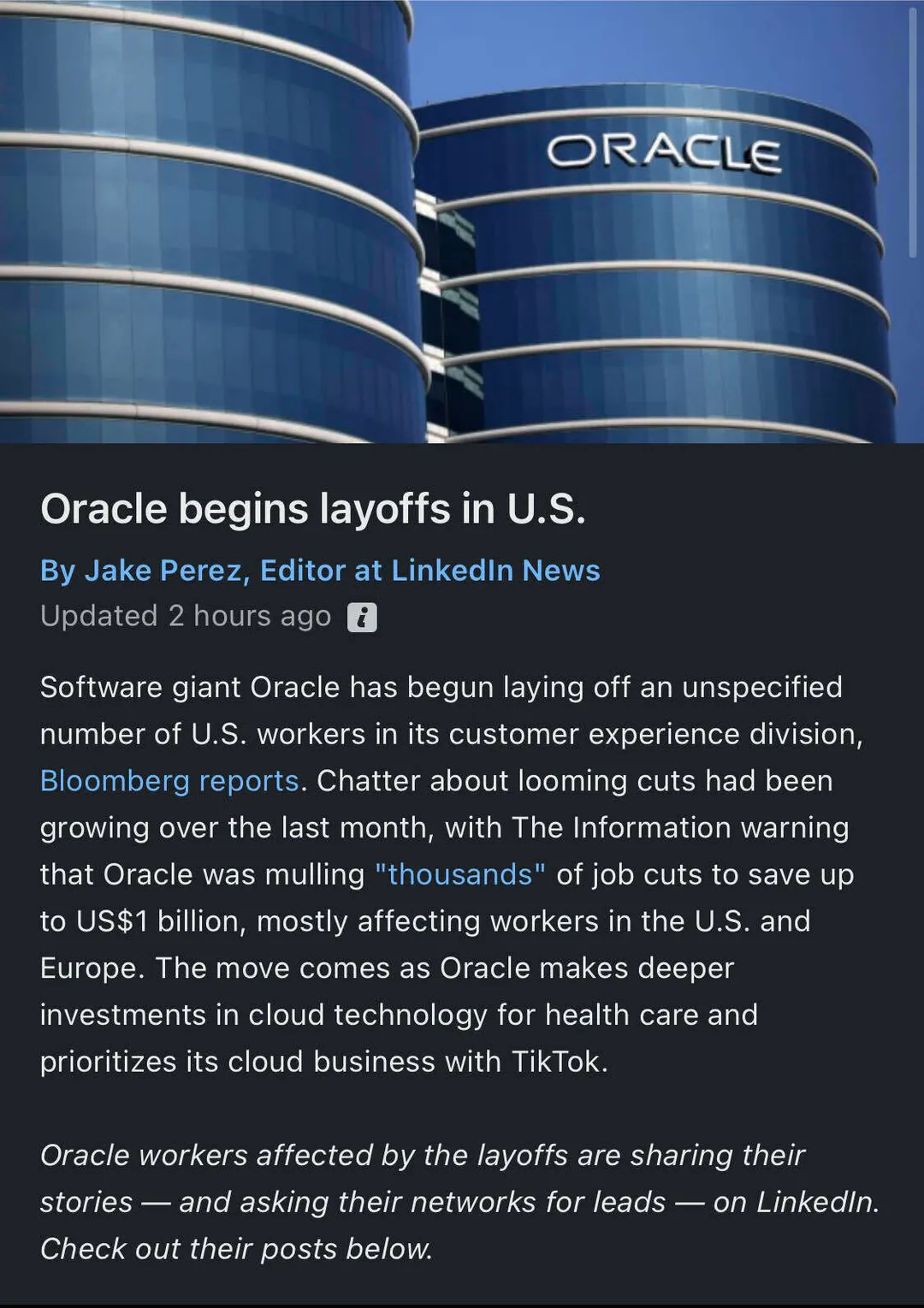
Oracle corporate headquarters
The image of an inbox that delivers the end of employment is now a recurring vignette of the modern tech era: terse messages, automated HR portals, and a cold conveyor belt of severance links. The recent reports that Oracle emailed as many as 30,000 employees with layoff notices after a dramatic profit surge — and the broader claim that tech companies have been cutting nearly 1,000 jobs a day at times — are not just shocking numbers. They are a prism revealing how profitability, investor pressure, automation, and strategic repositioning are colliding to reshape how large technology firms think about human capital.
What the Headlines Mean
At surface level, the juxtaposition is jarring: strong profits and sweeping cuts. It raises a simple question: why reduce labor after a surge in earnings? The short answer is that profit and headcount are separate levers. Companies can be profitable while simultaneously deciding that their capital allocation and organizational structure should change — often rapidly — to prioritize areas with higher expected returns, especially artificial intelligence, cloud infrastructure, and software-as-a-service (SaaS) optimization.
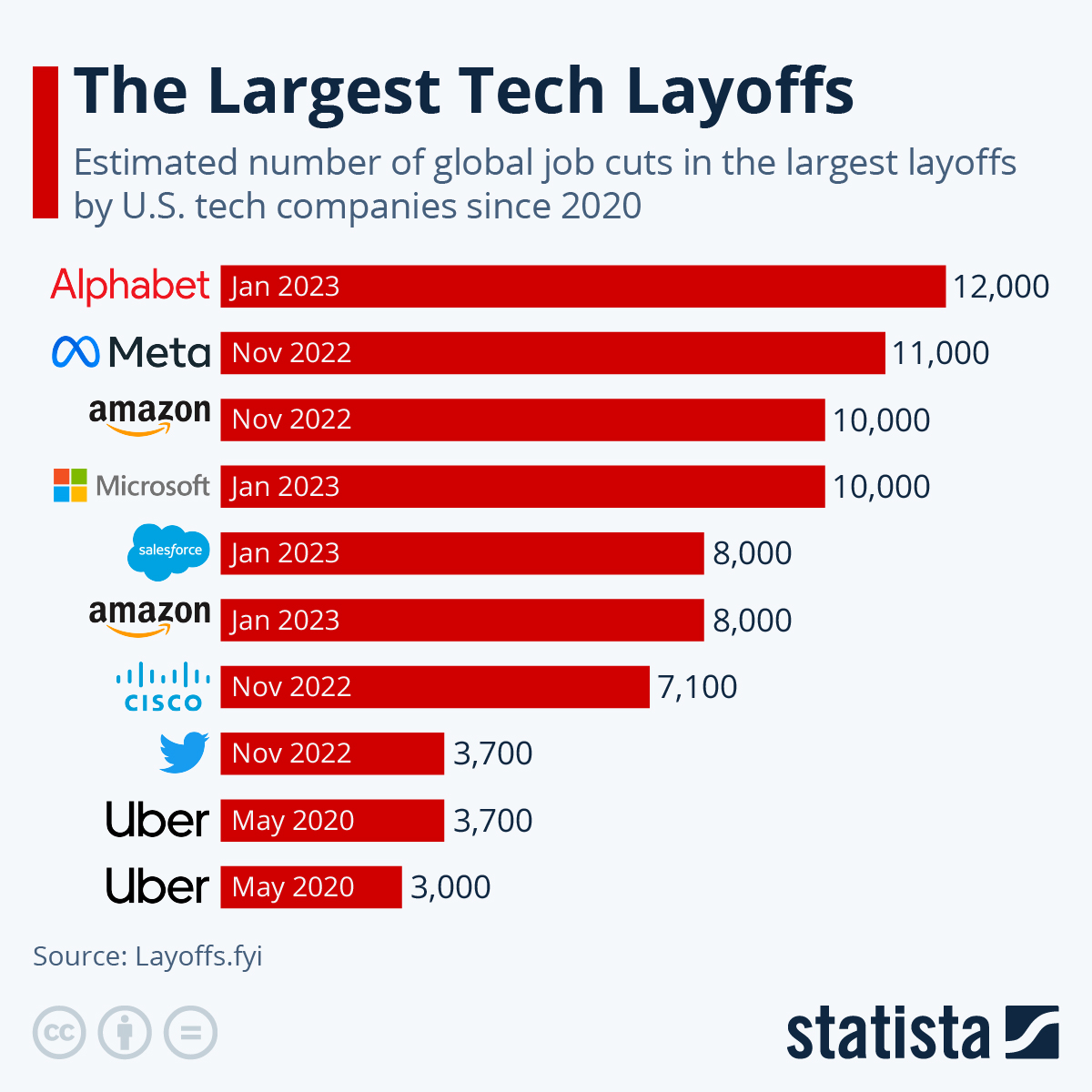
tech layoffs statistics chart
Why Companies Cut People During Profitability
There are several recurring motives that explain why profitable firms still downsize:
- Strategic reallocation. Management may decide that future growth requires more investment in product development, data infrastructure, or acquisitions rather than broad operational staffing.
- Automation and AI. Increased automation can allow companies to deliver the same or better services with fewer people, shifting costs from labor to technology.
- Margin improvement. Even profitable companies pursue higher margins — trimming roles perceived as duplicative or non-core can lift operating income and free cash flow.
- Investor signaling. Cost discipline is a clear message to markets that management is serious about capital efficiency, which can boost share price even while reducing workforce size.
- Post-merger rationalization. Large firms that acquire many companies often inherit overlapping teams and redundant functions that are later consolidated.
When these forces converge in a single firm, leadership can choose rapid workforce reduction as a blunt but fast method to transform the cost base.
The paradox: high profits don’t immunize employees from structural change; they often accelerate it.
The Math: What "1,000 Jobs a Day" Actually Means
Numbers like "nearly 1,000 jobs a day" are attention-grabbing, and it's useful to translate them into concrete context. At scale, persistent rates of layoffs add up fast. A daily rate of 1,000 positions removed becomes 20,000 a month (assuming 20 business days) and roughly 240,000 a year. Even if the 1,000/day figure represented short bursts rather than a sustained pace, it signals a rapid churn in employment status across dozens of firms simultaneously.

corporate email notifications
Table: Layoff Rate Examples
| Rate | Per Day (approx.) | Per Month (20 business days) | Per Year (12 months) |
|---|---|---|---|
| 500 jobs/day | 500 | 10,000 | 120,000 |
| 1,000 jobs/day | 1,000 | 20,000 | 240,000 |
| 3,000 jobs/day (peak bursts) | 3,000 | 60,000 | 720,000 |
These are simplified calculations, but they highlight scale: when a single enterprise reports layoffs in the tens of thousands, it can constitute a meaningful fraction of the overall daily industry churn.
How Big Companies Manage Notifications — And Why Email Happens
CEO-sent all-hands or HR-run in-person notifications are ideal for preserving dignity, but at very large scale — especially across geographies and time zones — companies sometimes rely on email or automated portals to communicate. There are practical reasons for this: speed, legal constraints, and the need for standardized documentation. Yet when firing practices default to mass email, the immediate human fallout is intense: bewilderment, reputational backlash, and morale erosion inside the surviving organization.
The Human Cost: Beyond Severance Numbers
Financial headlines often reduce layoff events to severance statistics and stock price reactions. The human stories are much messier: sudden loss of healthcare, the stress of finding new roles in a crowded market, disruption to families, and the mental-health burden of abrupt professional rejection. Contractors, vendors, and support staff — groups less visible in headlines — are frequently the most vulnerable.

laid off employees emotional
Companies can mitigate harm with thoughtful practices:
- Generous and clear severance. Transparent formulas for pay, extended health benefits, and help with visa transitions where applicable.
- Outplacement and reskilling support. Coaching, expedited references, and access to training credits for in-demand technical skills.
- Staggered notifications. Wherever possible, tailored conversations with managers instead of blanket emails.
- Compassionate communication. Leadership that explains rationale, acknowledges mistakes, and commits to support tends to preserve long-term employer brand.
What This Means for the Tech Labor Market
The immediate consequence of waves of layoffs is a larger candidate pool for a finite set of open roles. That dynamic can reduce newcomer bargaining power and shift hiring signals: employers become more selective, while reliable high-skill talent can become a seller's market again where demand is concentrated.
Longer term, several structural shifts are possible:
- Reallocation of talent to AI and cloud-native roles. Engineers and product managers with model deployment experience or cloud cost-optimization skills will be in disproportionate demand.
- Rise of contract and project-based work. Companies keen to preserve flexibility may hire more contractors or use shorter engagements, changing benefits and stability expectations.
- Geographic redistribution. Remote-first hiring can accelerate labor market globalization and reduce salary compression in traditional tech hubs.
Layoffs reshape not only who is employed today, but where work gets done and how careers are structured tomorrow.

tech labor market trends
Investor Incentives vs. Organizational Health
Public companies have to balance quarterly expectations with long-term strategy. When investors reward cost-cutting with a higher multiple, executives face strong incentives to deliver margin improvements quickly. That can lead to the perception — and sometimes the reality — that immediate shareholder returns are prioritized over employee retention or customer continuity.
That doesn’t mean layoffs are inherently short-sighted. In many reorganizations, removing layers of management or redundant teams genuinely frees up resources to invest in product innovation. The key differentiation is whether leadership has a clear plan to redeploy capital into growth areas or if cuts are a reflexive response to market jitters.
Practical Advice for Companies Planning Reductions
When layoffs are unavoidable, firms should treat them as strategic operations with rules and human-centered guardrails:
- Model scenarios in advance. Quantify the customer, legal, and cultural costs of different workforce-reduction strategies.
- Prioritize transparent timing. Coordinate public announcements, regulatory filings, and employee communications so people aren’t blindsided by news cycles.
- Invest in rehiring and retraining budgets. If product pivots require new skills, fund transition programs rather than assuming the market will absorb displaced workers immediately.
- Standardize compassionate practices. Ensure consistent severance formulas, immigration support, and references across business units.
Practical Advice for Affected Employees
For workers facing unexpected layoffs, pragmatic steps can improve outcomes quickly:
- Stabilize logistics first. Understand severance, healthcare end-dates, and any potential for contract conversion. Document everything.
- Prioritize short-term income. Consider consulting or contract work while you search for a full-time role; these gigs can bridge benefits gaps and keep skills current.
- Market your productized skills. Rapidly craft clear case studies of your impact — metrics, tangible results, and the problems you solved.
- Use networks intentionally. Reach out to former colleagues, managers, and industry contacts with a concise ask: signal availability and the roles you seek.
- Consider reskilling. Target adjacent, high-demand skills where your experience transfers quickly — cloud optimization, MLOps, observability, or cybersecurity.
Policy and Macro Considerations
When layoffs occur at scale, policymakers and community organizations must respond. Local unemployment offices, state benefits, and retraining programs often lack the resources to absorb sudden surges in need. Tech’s concentration in certain regions amplifies this effect: entire neighborhoods and service industries can feel the shock.
Policy responses that can help include:
- Expanded retraining grants. Subsidies for short, targeted upskilling programs aligned with employer demand.
- Portable benefits pilots. Experiments with benefits decoupled from employers — health, retirement catch-ups, and re-employment supports — make transitions less destructive.
- Stronger disclosure rules. Timely regulatory communication about material workforce changes helps workers and markets plan.
Reputation, Recruitment, and the Long Tail
Firms that handle layoffs poorly pay a reputational price that affects future hiring, customer trust, and even partnerships. Conversely, companies that are transparent, provide generous support, and demonstrate long-term commitment to employees often recover faster in talent markets. Employer brand matters: in an era where top engineers often have options, perceived fairness is a competitive advantage.

corporate restructuring meeting
Final Thoughts and What to Watch Next
The story of mass emails and big profits is not a single scandal; it’s a symptom of a broader transition. Tech companies are reorganizing into more capital-efficient, AI-focused entities. Investors are rewarding cost discipline. Workforce models are shifting toward more flexible, skills-driven engagements. Those trends can produce greater productivity and new product breakthroughs — but they also require candid conversations about ethics, worker protections, and shared responsibility.
- Profitability does not preclude large layoffs; it can accelerate strategic restructuring.
- Large-scale, email-based notifications are legally expedient but often inhumane and damaging to reputation.
- Layoff rates measured in hundreds or thousands per day scale quickly and reshape labor markets.
- Companies should invest in compassionate severance, retraining, and transparent communication.
- Displaced workers can respond with rapid reskilling, networking, and short-term contracting to bridge gaps.
Conclusion
The image of tens of thousands receiving termination notices by email after a profitable quarter crystallizes a new corporate reality: efficiency and strategic bets on technology frequently outweigh legacy employment structures. That reality can be navigated responsibly, but only if leaders make the choice to pair financial discipline with humane transition policies. For employees, the path forward emphasizes adaptability, networked opportunity, and continuous learning. For policymakers and communities, it means building smoother safety nets that reflect how modern work is organized — fast, distributed, and increasingly algorithmically mediated.
This feature aims to explain the forces behind mass layoffs and to offer practical guidance for organizations and workers navigating rapid change.