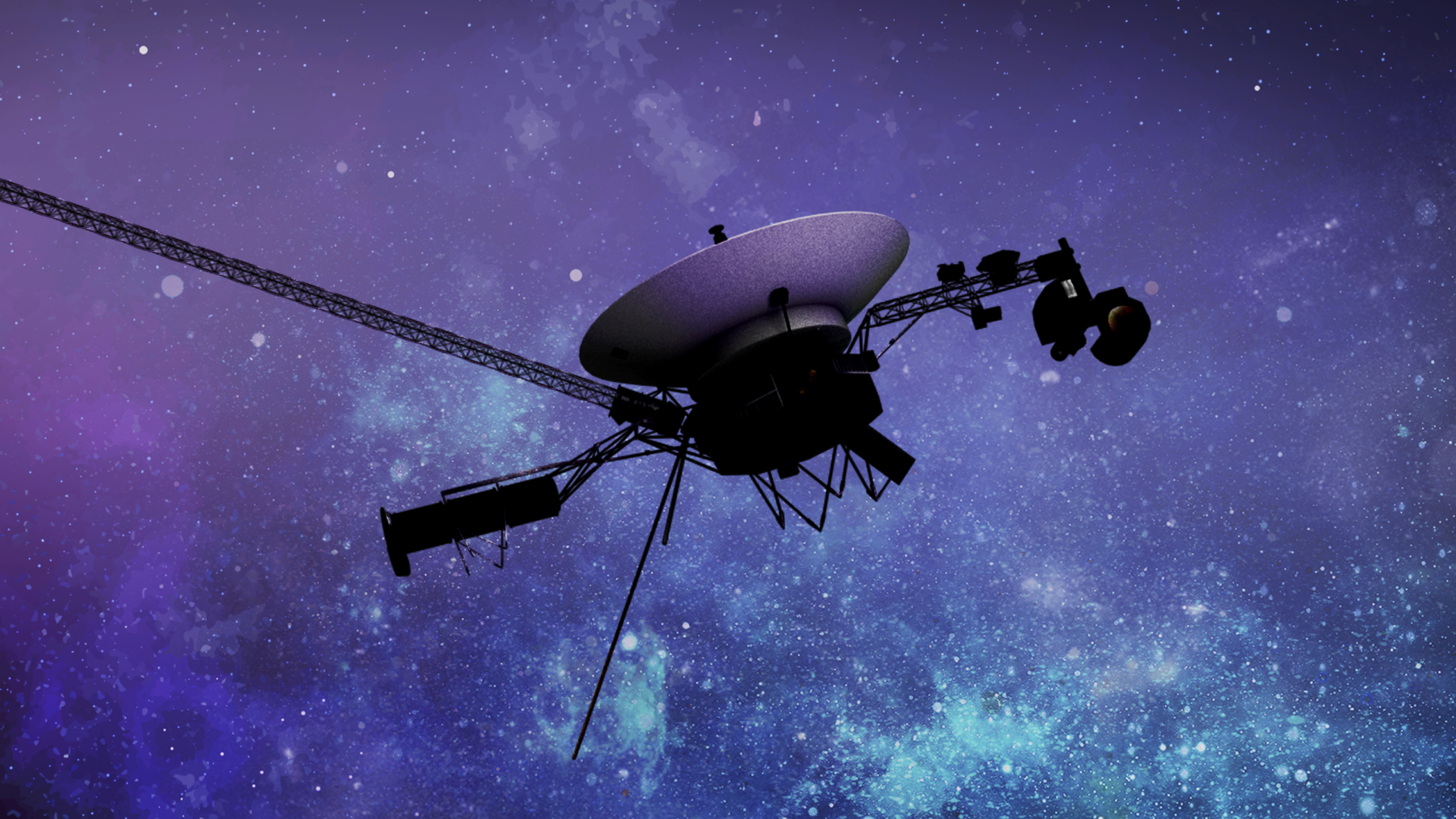
Voyager 1 Now 24 Light-Hours Away — Why the Delay Matters
When NASA’s Voyager 1 slipped away from Earth in 1977 it was a compact, state-of-the-art planetary probe built for a few years of exploration. Nearly five decades later it is something much stranger: a human-made object drifting through interstellar space so distant that a radio message—or a beam of light—takes roughly 24 hours to make the trip between our planet and the spacecraft. That single fact reshapes how engineers operate it, how scientists interpret its data, and how we, as a species, think about communicating across the solar system and beyond.
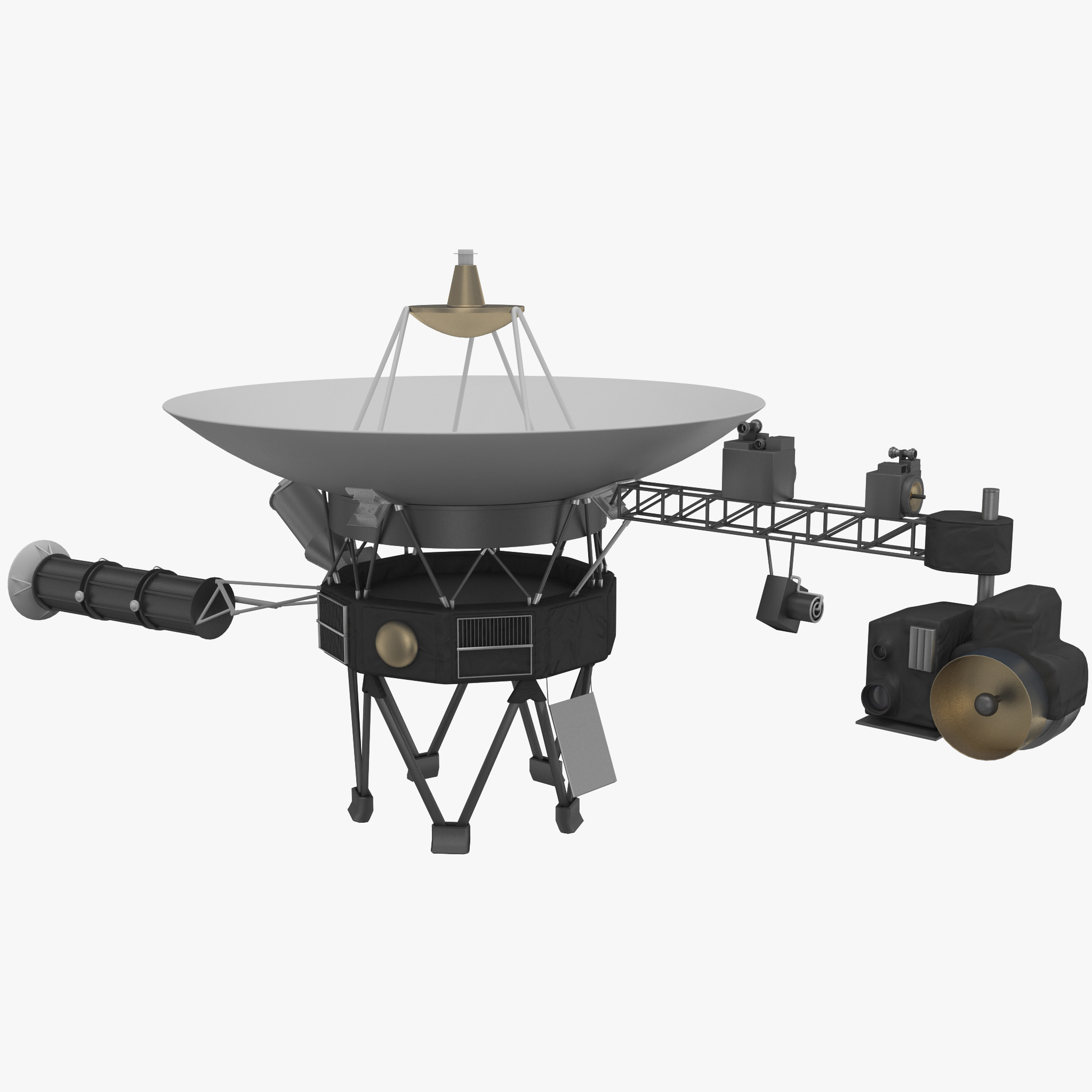
Voyager 1 spacecraft model
HOW FAR IS VOYAGER 1?
Distance in human terms
Numbers can feel abstract until we translate them. Saying that light takes 24 hours to reach Voyager 1 is the same as saying it is about 24 light-hours away. A light-hour is the distance light travels in one hour—about 1.08 billion kilometers—so 24 light-hours is on the order of 25 to 26 billion kilometers. Expressed in astronomical units (AU), where 1 AU is the Earth–Sun distance, Voyager 1 now sits tens to hundreds of AU from the Sun depending on its exact position along its outbound trajectory. That places it far beyond the planets and well into the sparsest reaches of space where the particles and magnetic fields of the solar wind have thinned to a whisper.
What "light time" actually measures
Light-time is a convenient way to capture both distance and communication latency. For radio engineers and mission controllers the light-time is the fundamental clock: every command sent requires at least that much time for a reply, and every telemetry packet returning to Earth is stamped with information that will arrive only after that delay. Light-time replaces the familiar seconds-and-minutes we use for Earthbound communication with a new, much longer cadence.
At 24 light-hours, talking to Voyager is less like a phone call and more like leaving a message for someone who will respond tomorrow—if all goes well.
WHY 24 LIGHT-HOURS MATTERS
Command and response delay
When round-trip light-time approaches two days, mission operations become exercises in patience and planning. A command uploaded from Earth will be received by Voyager 1 after about 24 hours; any acknowledgement or resulting science data will take another 24 hours to return. That means a single interaction—issue an instruction and confirm its execution—can consume a full day. Engineers must anticipate spacecraft behavior and avoid relying on rapid back-and-forth corrections.
Autonomy and pre-programming
With such long latencies, spacecraft need to be able to take care of themselves. Voyager’s original design anticipated some autonomy: it could record data, execute pre-planned sequences, and handle basic safing routines. But modern expectations for autonomy are far greater. For legacy missions like Voyager, the operational model is to carefully script activities, simulate expected behavior on the ground, and only send commands when confident. If Voyager encounters an unexpected situation, ground teams must wait—sometimes 24 hours or more—before knowing whether the spacecraft executed a corrective maneuver.
Data rate and signal strength
Distance directly affects the rate at which data can be transmitted. Radio signals weaken with the square of distance; as Voyager recedes, its signal arriving at Earth spreads into an ever-larger sphere and carries less power per square meter. To compensate, mission engineers reduce data rates, compress and prioritize information, and use the enormous Deep Space Network antennas to collect faint transmissions. Every additional AU costs scientific bandwidth.
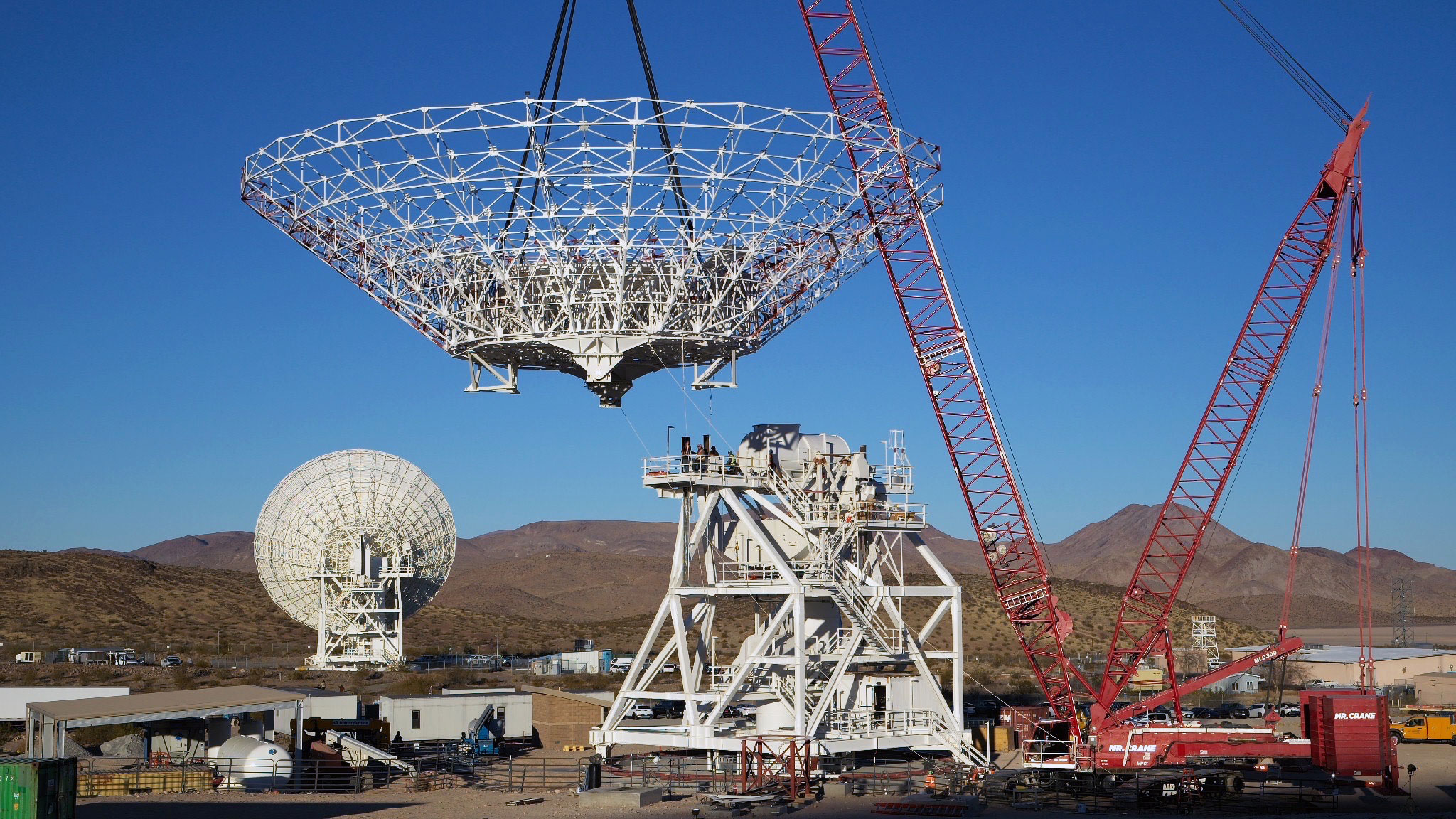
Deep Space Network antenna
A BRIEF HISTORY: HOW VOYAGER GOT HERE
From planetary tour to interstellar probe
Voyager 1 left Earth in 1977 on a trajectory that used gravity assists to visit Jupiter and Saturn, returning a revolution of imagery and measurements that reshaped planetary science. After its planetary encounters the spacecraft was directed on a path that eventually carried it out of the heliosphere—the bubble carved by the Sun’s magnetic field and solar wind—into interstellar space. In doing so it became the first human-made object to directly sample the interstellar medium, providing landmark measurements of charged particles and magnetic fields beyond the Sun’s influence.
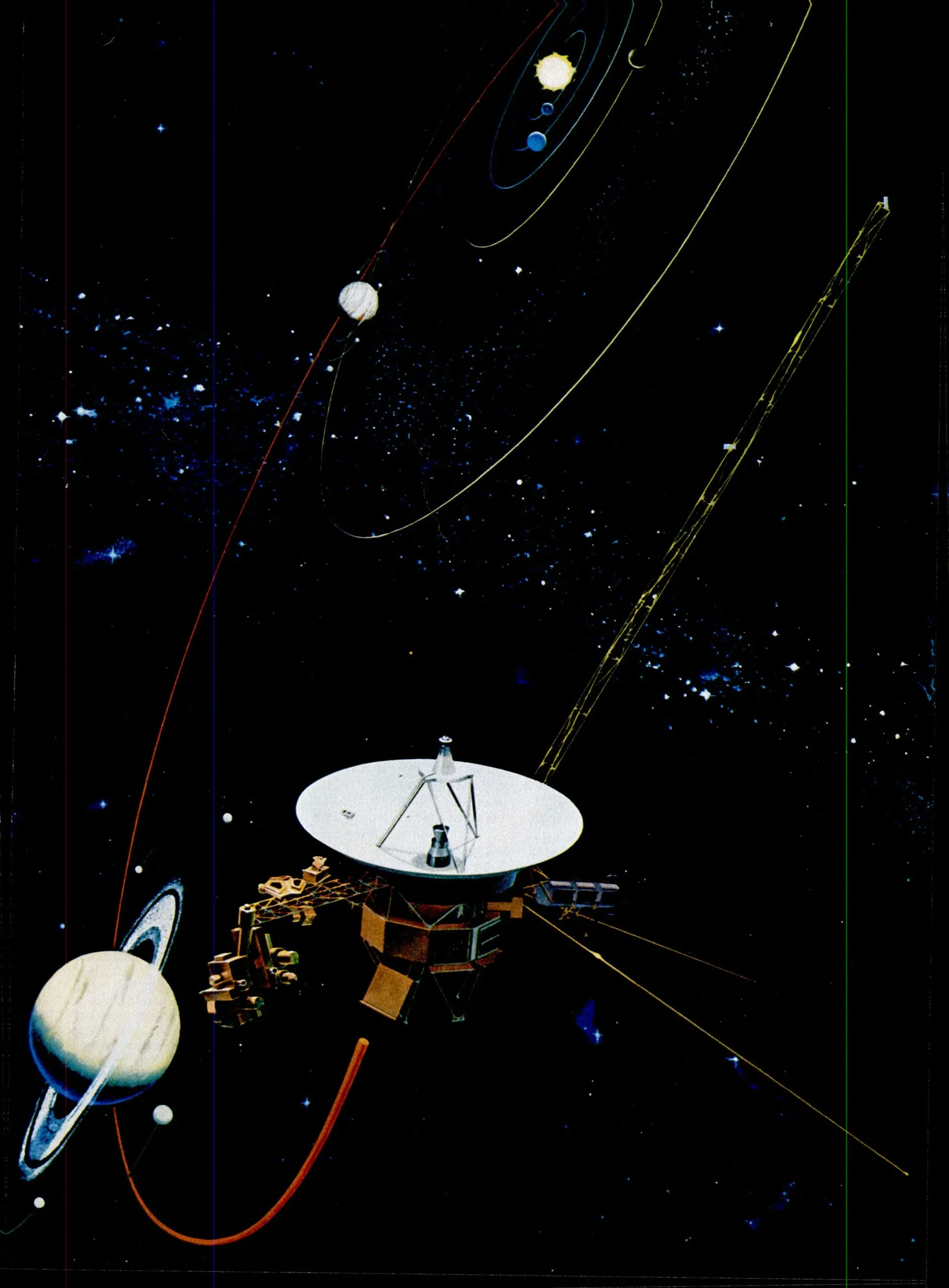
Voyager 1 Jupiter Saturn flyby
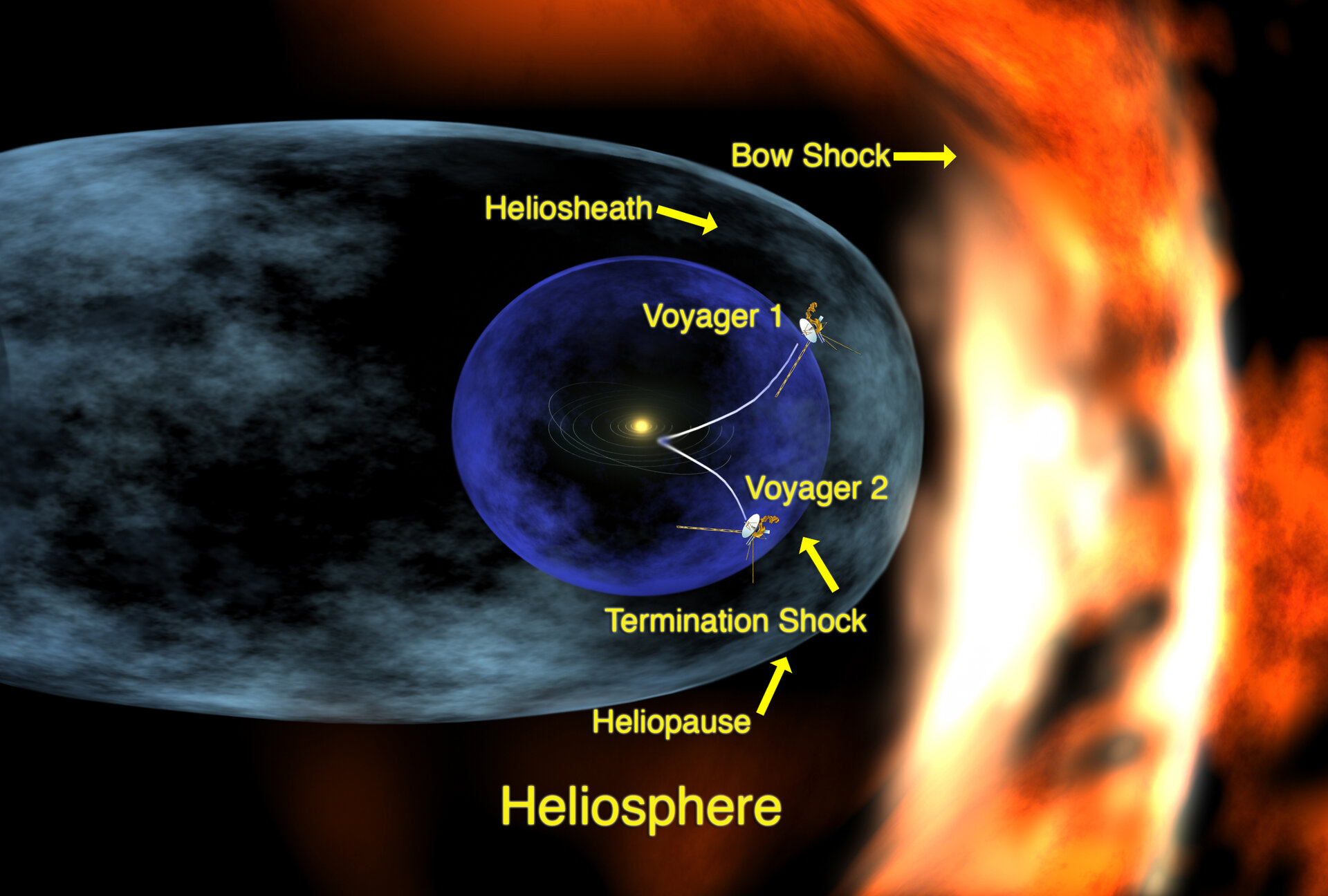
heliosphere interstellar space diagram
Engineering resilience
Engineers never expected the Voyagers to function for decades; they designed them to survive a daring multi-planet tour. Keeping Voyager 1 operational into interstellar space has required a campaign of careful resource management: turning off heaters and nonessential instruments, reorienting antennas precisely, and tailoring operations to a slowly declining power budget. This maintenance by remote command, across ever-growing light-time delays, is a testament to both the original hardware and the teams who have supported it through multiple generations.
HOW VOYAGER STAYS ALIVE
Power from radioisotope thermoelectric generators
Voyager’s energy comes from radioisotope thermoelectric generators, or RTGs, which convert heat from decaying plutonium into electricity. RTGs provide reliable, long-lived power but they decline slowly over time as the plutonium decays and thermoelectric efficiency drops. To stretch that power, mission teams selectively deactivate nonessential systems and sequence science observations to conserve electricity for the instruments and transmitters that provide the most valuable data.
radioisotope thermoelectric generator RTG
Aging electronics and thermal management
Components designed in the 1970s are now operating far past their intended lifetimes. Wiring, sensors, and onboard computers have to cope with lower voltages and temperatures that can swing dramatically in deep space. Engineers mitigate risk through careful power budgeting, commanding Voyager to orient itself to keep critical systems warm, and minimizing thermal stresses. Every sunless rotation and every turned-off heater reduces margin—but prolongs life.
WHAT SCIENCE CONTINUES TO RETURN
Interstellar environment measurements
Even with limited instruments, Voyager 1 remains a unique sentinel. It measures charged particles, magnetic fields, and cosmic ray flux—data that cannot be obtained from inside the heliosphere. Its readings help scientists understand how the Sun’s influence fades and how interstellar plasma behaves where the solar wind meets true interstellar material.

interstellar medium cosmic rays
Long-baseline advantage
Voyager’s location provides a baseline for comparing measurements from probes closer to the Sun. This long baseline is valuable for studying gradients—how particle density and field strength change with distance—and for validating models of the heliosphere’s shape and dynamics.
OPERATIONS, LIMITATIONS, AND RISK
Limited recovery options
At 24 light-hours one cannot troubleshoot in real time. If Voyager’s transmitter failed or an antenna pointed wrong, the simplest fixes—instant retries or manual steering—are impossible. Teams must design commands to reduce risk and accept a degree of irreversible loss. For particularly risky operations, extensive simulation and staged rollouts reduce the chance of a permanent failure.
The role of the Deep Space Network
The Deep Space Network (DSN) is the collection of large radio antennas on Earth that listen for and transmit to distant spacecraft. When you hear about faint signals from Voyager, it is the DSN’s sensitivity that makes communication possible. The DSN schedules hours or days of contact windows, points massive dishes precisely, and uses sophisticated signal processing to pull Voyager’s whisper out of radio noise.
PUTTING THE DISTANCE IN PERSPECTIVE
Speed and future trajectory
Voyager 1 is still moving outward, slowly but steadily. Its speed relative to the Sun is on the order of tens of kilometers per second—fast by human standards but infinitesimal on interstellar scales. Even if it coasts forever, reaching even the nearest star system would take tens of thousands of years. That perspective explains why the mission’s legacy is not eventual arrival somewhere else, but the steady stream of scientific data it sends back while it is still reachable.
A human connection across a day
Finally, consider the cultural meaning. At 24 light-hours Voyager is, literally, a message in a bottle whose reply arrives the next calendar day. In an age of instant messaging and streaming, this is an almost meditative reminder of scale: the patience required to operate across cosmic distances, the ingenuity of engineering, and the persistence of curiosity.
CONCLUSION
Voyager 1’s status—so distant that light requires about 24 hours to travel between it and Earth—is more than an interesting fact. It is a lens onto the practical challenges of deep-space operations, the slow, inexorable decline of an aging spacecraft, and the continuing scientific value of a probe launched in a different era. The mission demonstrates how careful engineering, conservative operations, and decades of institutional memory can keep a small piece of human technology sending back insights from well beyond the planets.
Key takeaways
- Latency: A 24-hour one-way light-time fundamentally changes command cycles and requires script-driven operations.
- Power constraints: RTG decay forces careful prioritization of instruments and heaters.
- Unique science: Voyager continues to provide measurements from interstellar space that no active mission can duplicate.
- Human perspective: Communicating with Voyager is an exercise in long-term thinking—both technically and culturally.