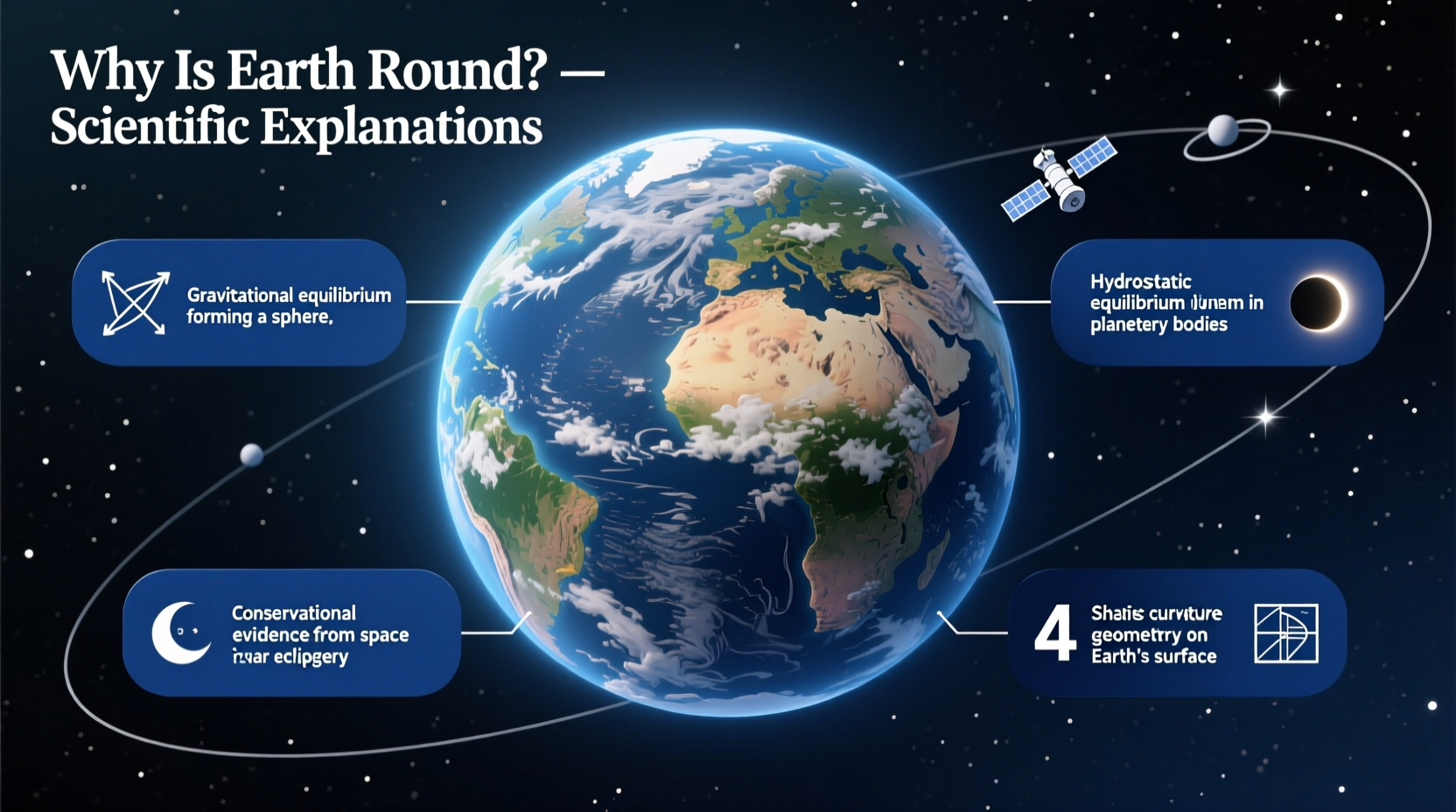
How to Give One Irrefutable Proof the Earth Is Round
When your teenage stepson starts asking questions — or telling you he now believes the Earth is flat — it can feel like an urgent, delicate conversation: urgent because falsehoods spread quickly online; delicate because teenagers often hold conspiratorial beliefs for identity reasons, not just intellectual ones. Before you try to persuade him with statistics or authority, it's powerful to show one piece of evidence so straightforward that it doesn't rely on trust in scientists, institutions, or remote images. This article lays out that single, most irrefutable proof, then supports it with practical demonstrations, everyday observations, historical context, and communication tips so you can turn curiosity into understanding without humiliation or argument.
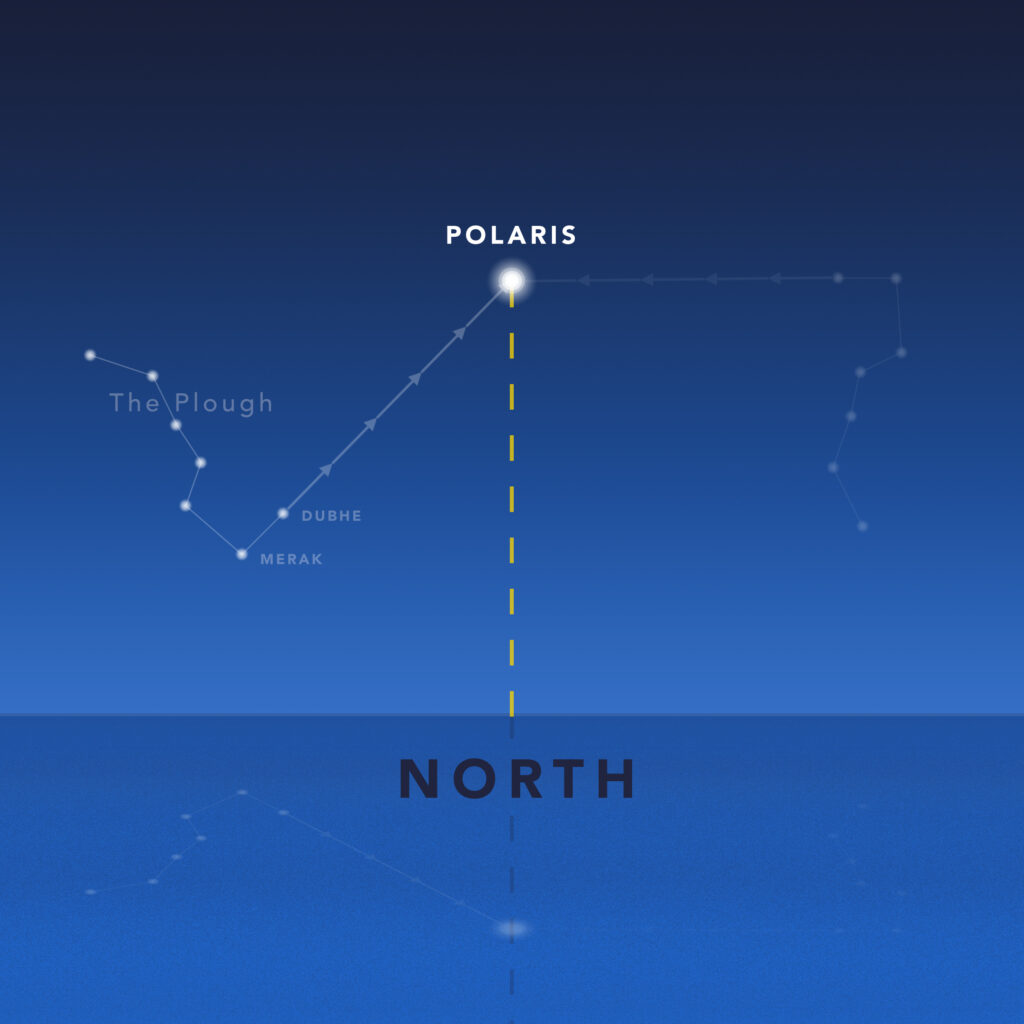
Polaris star navigation
THE MOST IRREFUTABLE, DEFINITIVE PROOF
1. The single proof: synchronized observations of a single celestial event
The clearest, hardest-to-deny proof that the Earth is spherical is this: observers at different, well-separated locations around the globe see different portions of the sky and different timings of the same celestial phenomena in a way that only makes sense if observers stand on a curved surface. The cleanest example is the timing and geometry of a lunar eclipse, or alternatively simultaneous observations of a star's altitude and the Sun's angle at local noon. These observations are repeatable, can be performed with simple instruments, and rely on geometry rather than authority. They are also verifiable by independent witnesses in many places at once.
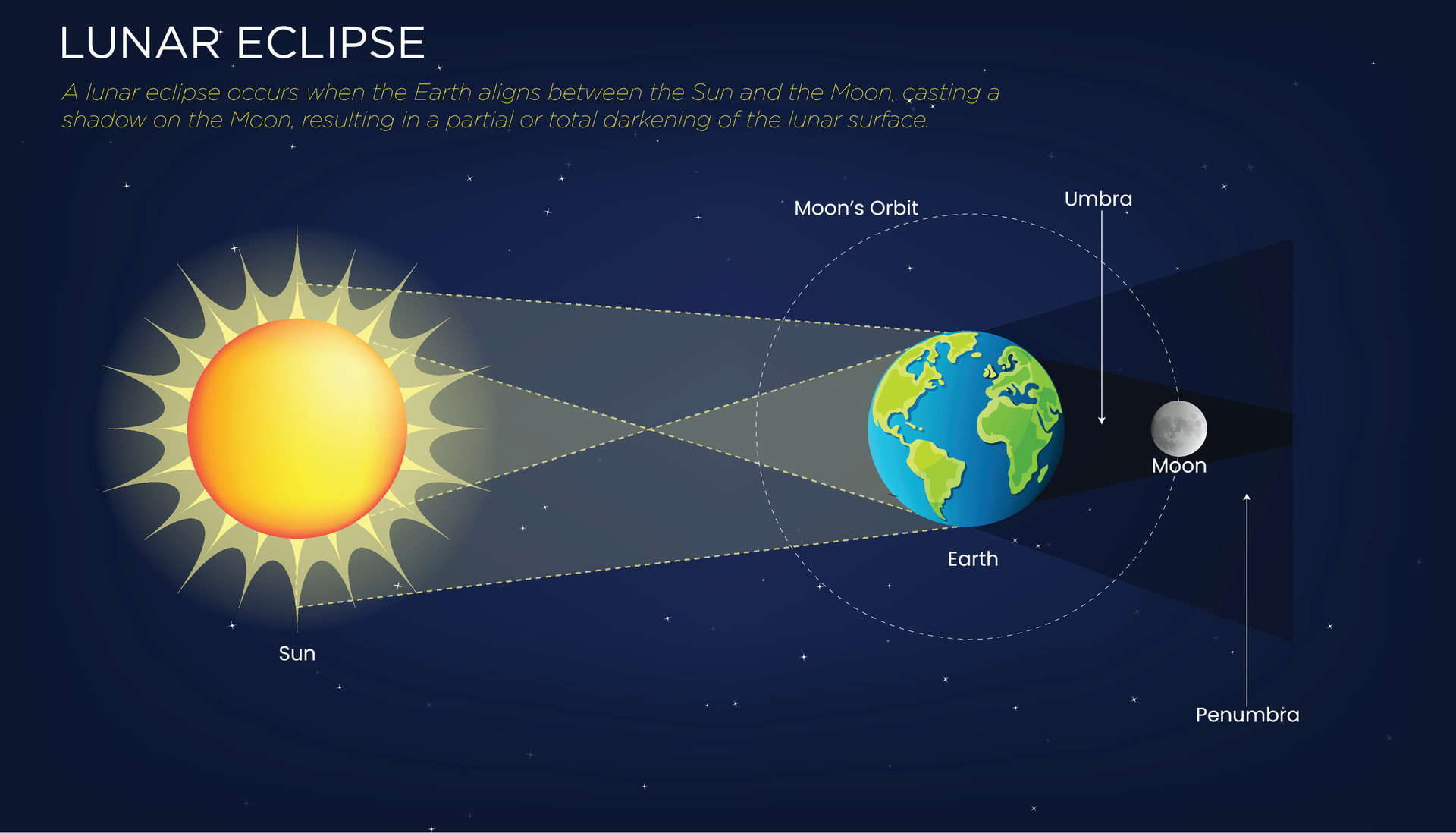
Lunar eclipse Earth shadow
Why this works
Imagine two people separated by thousands of kilometers. If the world were flat, the Sun and stars would present the same angles to both observers at the same time. But in reality, the angle from the observer to a celestial object changes predictably with latitude and longitude: at local noon the Sun is higher in the sky near the equator and lower toward the poles; during a lunar eclipse, the Earth's circular shadow passes across the Moon in a curved arc visible from many points. These differences match the geometry of a sphere exactly. In plain language: the sky looks different from different places in a pattern that only a globe explains.
Practical demonstrations you can do with your teen
2. Eratosthenes' shadow experiment (simple, elegant, historical)
In about 240 BCE Eratosthenes measured the angle of the Sun's rays at two cities in Egypt at noon on the summer solstice and used the difference to estimate Earth's circumference. You can recreate a modern version with two people standing in different towns, or even two households a few dozen kilometers apart.
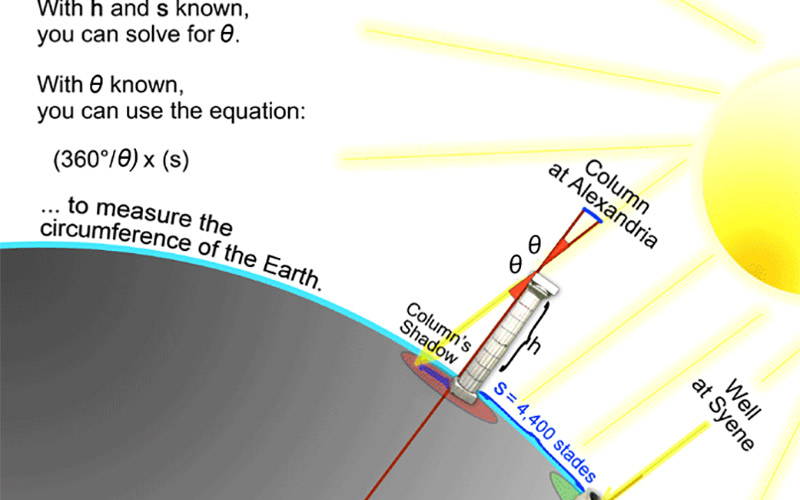
Eratosthenes shadow experiment
How to do it:
- Pick the same calendar day and local noon (when the Sun is highest in the sky at each location).
- Use a straight vertical stick (gnomon) and measure the length of its shadow to calculate the Sun's angle above the horizon.
- Compare the two angles and the distance between locations to compute the Earth's curvature with the same spherical geometry Eratosthenes used.
Result: if the Earth were flat, the measured angles would match exactly (after adjusting for small measurement errors). They don't; the difference matches a globe.
3. Watch a ship disappear over the horizon
This is intuitive and immediate. When a boat sails away from a shore, its hull disappears before its mast. The disappearing order matches the curve of a round surface: the lower parts dip below the horizon first. You can confirm with binoculars: even when the hull is gone, the mast may still be visible, and it reappears bottom-first when the ship returns.
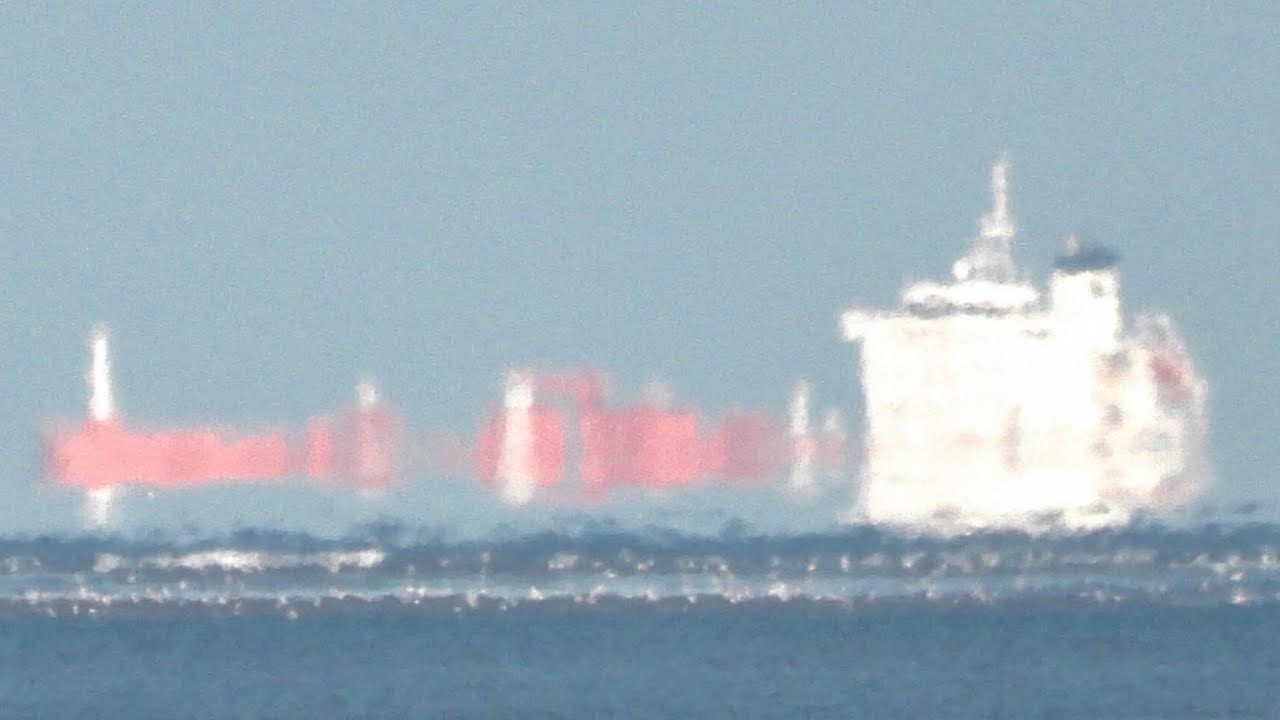
Ship disappearing over horizon
4. Time zones and sunrise/sunset times
Sunrise and sunset happen at very different clock times across longitudes. If the Earth were flat and the Sun simply moved like a spotlight above a disc, the pattern of sunrises, sunsets, and the sequence of time zones would be much more chaotic and locally inconsistent. Instead, the predictable progression of daylight across the globe matches a rotating sphere illuminated by a distant Sun.
Observable, technological, and historical proofs
5. Photographs and live video from space (visual but not the only proof)
Photos and live video from spacecraft, satellites, and the International Space Station show a round Earth. While convincing to many, these are sometimes dismissed by conspiracy-minded teenagers who claim the images are fabricated. That's why pairing visual evidence with geometry-based experiments (like Eratosthenes) is more effective: the latter doesn't require faith in institutions.
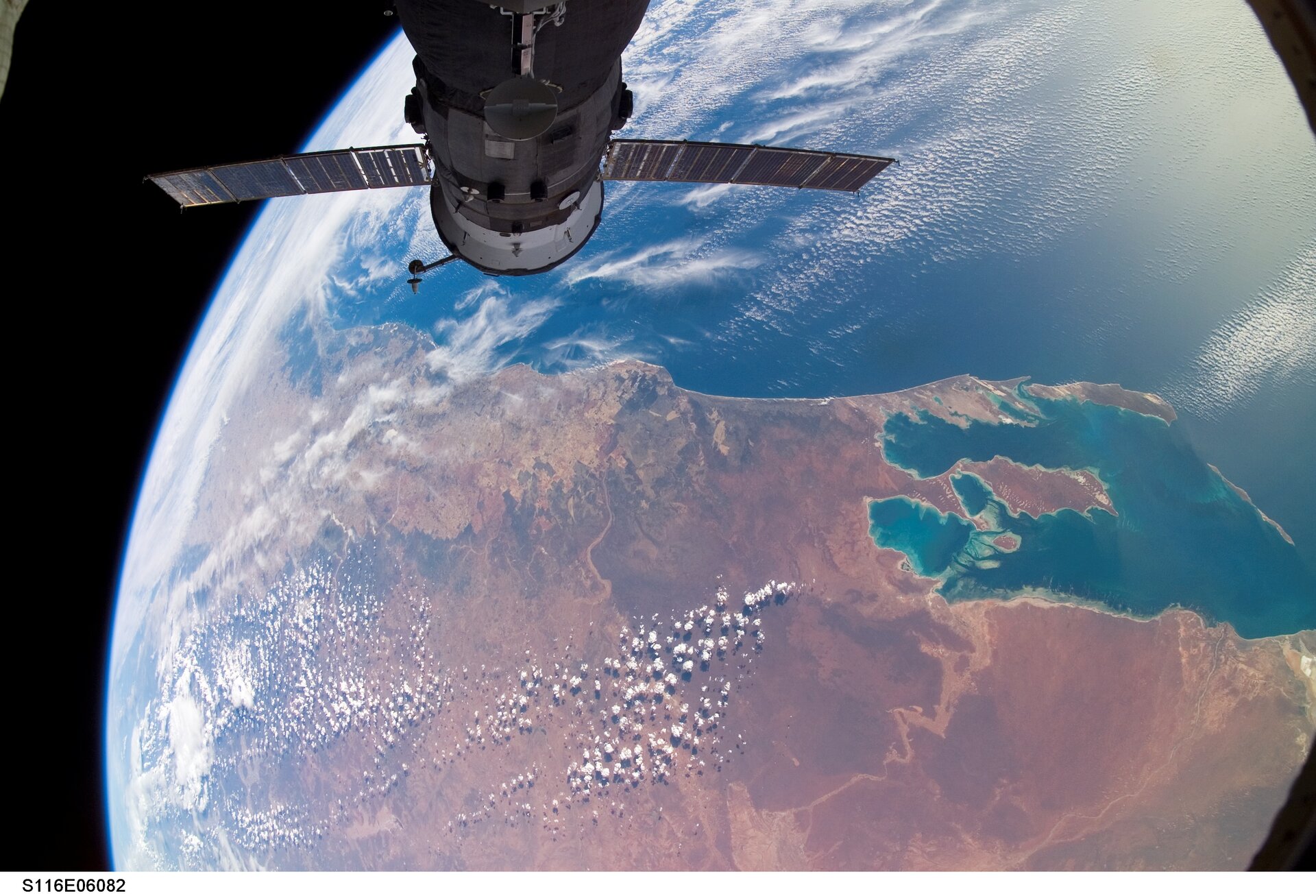
International Space Station Earth view
6. Circumnavigation and flight paths
Commercial ships and aircraft regularly travel routes that only make sense on a globe. Long-haul flight times between continents, the shape of airline routes, and the existence of antipodal points (locations directly opposite each other on the globe) all correspond to spherical geometry. A circumnavigation — traveling continuously in a roughly straight line and ending up back where you started — directly contradicts flat models that do not allow for such continuity without impossible shortcuts.
7. The curvature in long-distance photography and high-altitude balloon footage
From high enough altitude, the curvature of the horizon becomes visible. Amateur high-altitude balloon projects routinely reach heights where the horizon curves perceptibly. While you don't need to trust any single video, geometric experiments combined with multiple independent observations from different teams converge on the same conclusion: a sphere.
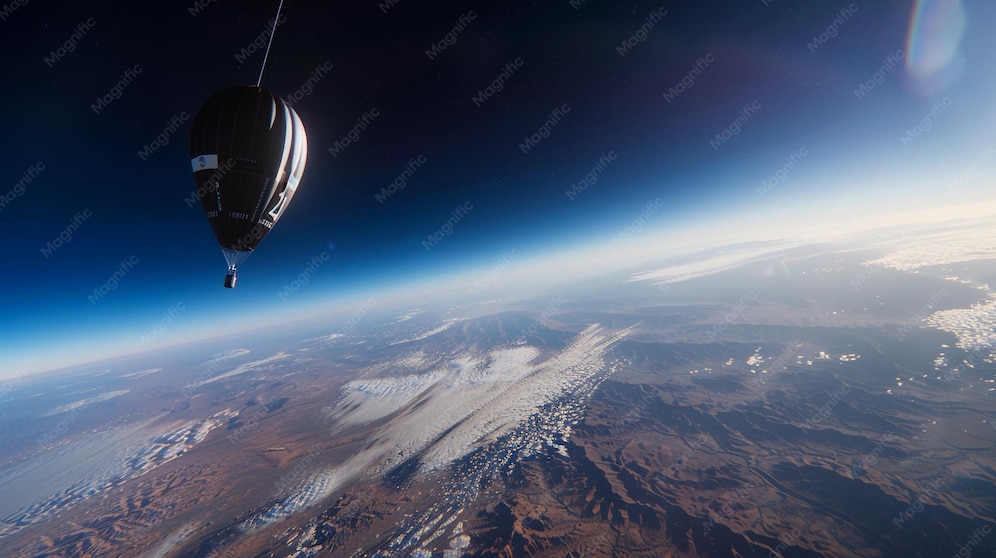
High altitude balloon curvature
How to address common flat‑earth arguments
8. "The horizon always looks flat"
The horizon appears flat at human scale because the Earth's radius is enormous compared with any everyday distance. The curvature becomes obvious only across tens of kilometers, from high altitude, or via precise measurements like Eratosthenes' method. A helpful analogy: a great circle looks flat if you stand on a tiny patch of it.
9. "Photos are faked"
When faced with accusations of fakery, steer the conversation back to repeatable geometry-based observations rather than images. Offer to perform or witness an experiment together: measure shadows at two locations, time a lunar eclipse, or observe star differences from two latitudes. These are independent of any organization's honesty.
10. "Gravity is a lie / objects fall downward"
Gravity as a physical explanation helps unify many observations — from why water sticks to the Earth to why atmospheres follow a planet — but you don't need to debate gravitational theory to show spherical geometry. Even without invoking gravity explicitly, measured angles and eclipses produce the same conclusion: a curved surface.
The strongest persuasion is not telling someone they are wrong, but inviting them to reproduce the experiment and see the result firsthand.
Communication strategies: how to talk to your teen
11. Ask questions before answers
Start with curiosity. Ask what convinced them, which videos or posts, and what type of evidence would change their mind. Teens are more likely to engage if they feel heard rather than corrected.
12. Offer hands-on experiments as challenges, not corrections
Present Eratosthenes's experiment or the ship-on-the-horizon observation as a fun project: "Let's try an experiment together to see which explanation matches reality." Framing it as collaborative reduces defensiveness.
A short historical perspective
13. From ancient measurements to modern geodesy
Knowledge that the Earth is spherical predates modern science. Greek scholars estimated circumference; navigators used stars to find position; 19th- and 20th-century geodesy refined the Earth's shape into an oblate spheroid — slightly flattened at the poles. The continuity from simple shadow measurements to GPS-based geodesy is a chain of independent methods all agreeing on the same shape.
Practical checklist: experiments and observations to try
- Shadow experiment: Coordinate with someone tens or hundreds of kilometers away at local noon and compare Sun angles.
- Horizon observation: Visit a lake or coastline, watch a ship leave and note which parts disappear first.
- Lunar eclipse timing: Observe or record a lunar eclipse and compare notes with distant observers.
- Star altitude comparison: Measure Polaris' elevation from two different latitudes; the angle changes predictably with latitude.
- High-altitude footage: Watch multiple independent balloon launches; note the curvature and compare claims about camera lenses.
Conclusion
There is no single piece of evidence that will magically end every doubt for every person. But one exceptionally robust approach combines geometry with shared observation: coordinate synchronized measurements of celestial events or shadow angles and compare results. These experiments do not depend on trusting institutions or images — they depend on basic geometry and the agreement of independent observers. Used gently, they give your teen the chance to see for themselves how the world fits together and why the globe model explains observations so cleanly.
- Use synchronized, repeatable observations (Eratosthenes-style or eclipse timing) as the most irrefutable proof.
- Combine simple experiments with everyday observations (ships, time zones, star angles) for reinforcement.
- Approach conversation collaboratively: invite experiments rather than debate conclusions.
When a teenage mind is willing to test and observe, the best tool isn't a lecture — it's an experiment that lets the evidence speak. Do that, and you'll give them something harder to ignore than any viral video: direct, empirical experience.