The New Era of Supernova Cosmology: Charting Dark Energy with Millions of Exploding Stars
The Cosmic Yardstick: Type Ia Supernovae
Type Ia supernovae have earned their title as "standard candles" due to their remarkably consistent peak brightness. This consistency arises from their unique origin: a white dwarf star in a binary system accretes matter from its companion until it reaches a critical mass threshold, triggering a runaway thermonuclear explosion. Because this threshold is nearly identical each time, the explosions are remarkably uniform.
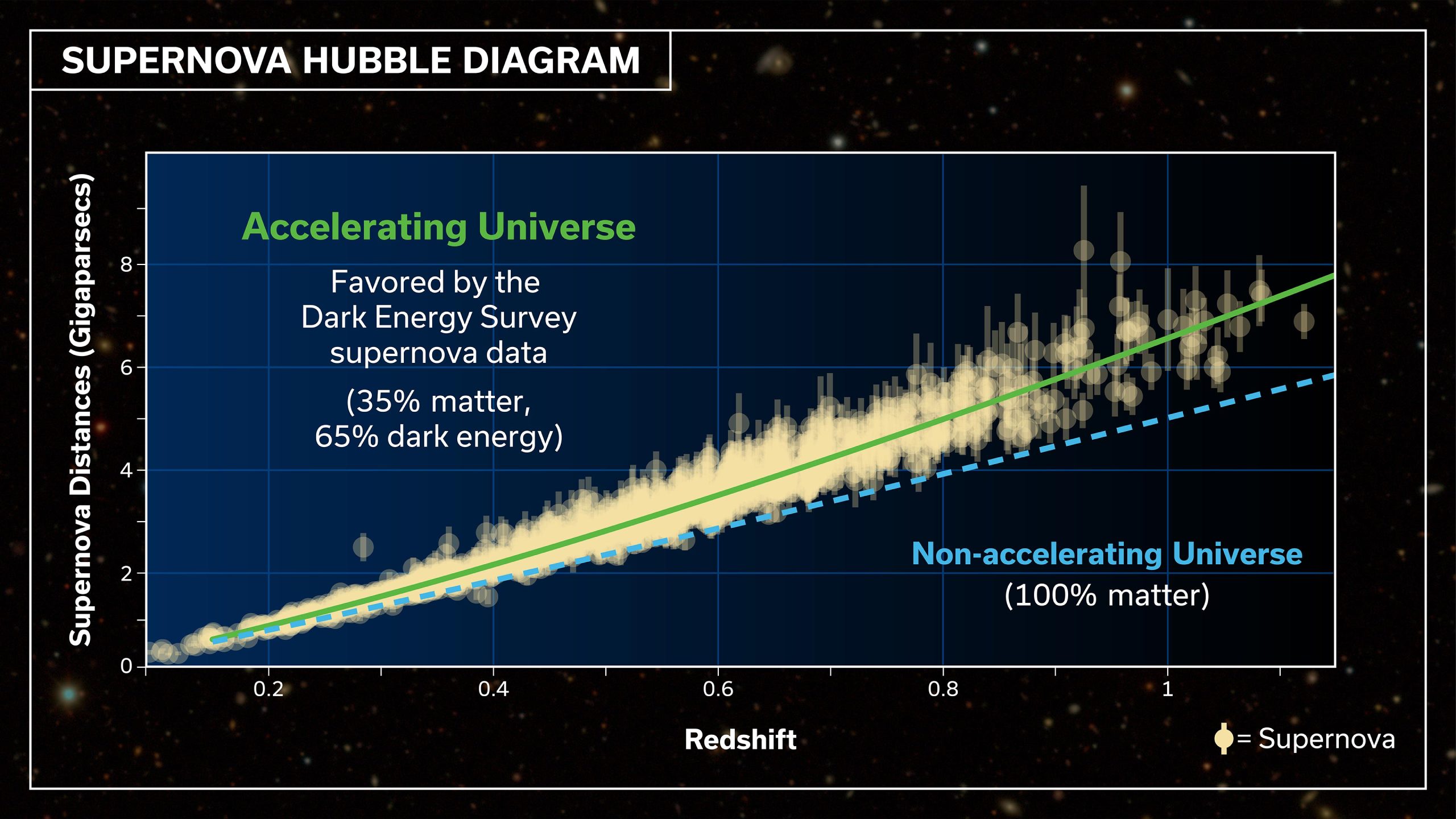
By comparing this known intrinsic brightness to how dim the supernova appears from Earth, astronomers can calculate its distance with great accuracy. In the late 1990s, measurements of distant Type Ia supernovae revealed they were fainter—and thus farther away—than expected in a universe decelerating under gravity. The shocking conclusion: the expansion of the universe is speeding up, propelled by an unknown repulsive force now called dark energy.
The Coming Flood of Light Curves
The legacy of this discovery rests on merely a few hundred supernovae. The next generation of sky surveys will increase this number by a factor of ten thousand. The Vera C. Rubin Observatory's Legacy Survey of Space and Time (LSST) will scan the entire visible southern sky every few nights, alerting astronomers to new supernovae in near real-time.
Complementing this, NASA's Nancy Grace Roman Space Telescope will perform ultra-deep, high-resolution infrared surveys. Roman's key advantage is its ability to peer through cosmic dust and observe supernovae at extremely high redshifts, mapping the universe's expansion back to when it was only about 2 billion years old.
For each detected supernova, these instruments will automatically generate a "light curve"—a plot of its brightness changing over time. The precise shape of this curve allows astronomers to refine the distance measurement and classify the supernova type.
Mapping the Expansion History
With millions of supernovae distances mapped across billions of light-years, astronomers will construct a detailed chart of the universe's expansion rate over cosmic time. This history is the key to understanding dark energy. Is it a constant force, as represented by Einstein's cosmological constant (Λ)? Or does it vary over time, suggesting a more complex dynamic field? The statistical power of millions of supernovae will allow us to measure the "equation of state" of dark energy with exquisite precision.
This massive dataset will also enable powerful cross-checks with other cosmological probes. For instance, the large-scale distribution of galaxies exhibits a pattern known as baryon acoustic oscillations (BAO), which provides a separate standard ruler. Comparing expansion histories from supernovae and BAO will test for systematic errors and confirm the robustness of our cosmological model.
Challenges and Opportunities
Harnessing this flood of data presents monumental challenges. Automated pipelines must classify events, measure light curves, and calibrate distances—tasks traditionally done by small teams of researchers. Machine learning and artificial intelligence are now essential tools for this effort. Furthermore, understanding subtle astrophysical effects, like how the host galaxy environment influences a supernova's brightness, will require careful analysis of the data.
The payoff, however, will be a transformation in our understanding of the cosmos. We will move from merely confirming the existence of dark energy to precisely characterizing its properties. This could finally point toward a physical explanation for dark energy, potentially requiring new physics beyond our current fundamental theories.
References & Further Reading:
- The Supernova Cosmology Project (https://supernova.lbl.gov)
- Vera C. Rubin Observatory Legacy Survey of Space and Time (https://www.lsst.org)
- NASA's Nancy Grace Roman Space Telescope (https://roman.gsfc.nasa.gov)
- Brout et al., "The Pantheon+ Analysis: Cosmological Constraints," ApJ, 2022.
© 2023 Cosmology Blog. All images credited as noted.