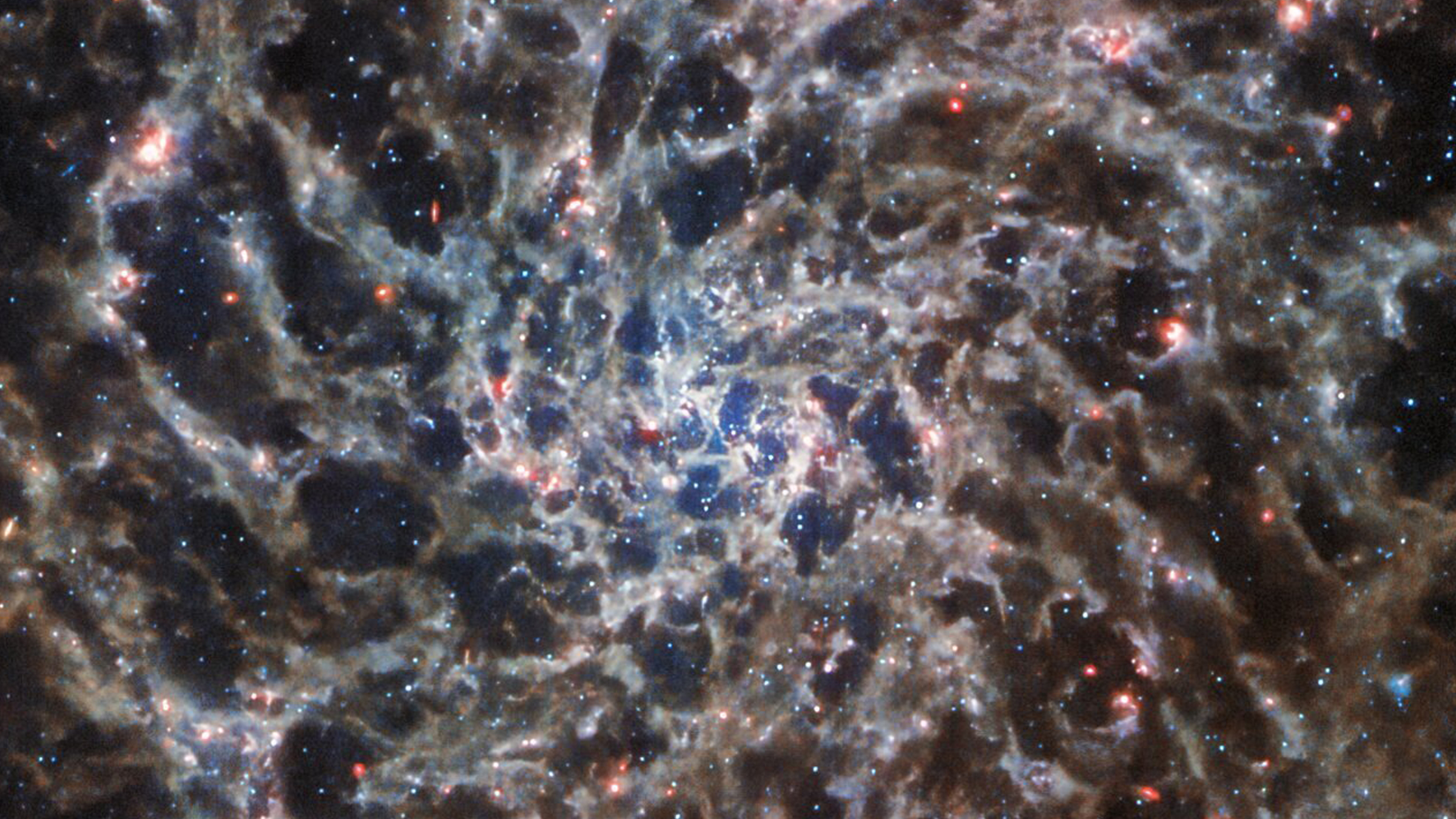
James Webb Finds Giant Cosmic Structure That Baffles Cosmologists
The James Webb Space Telescope has once again pulled back the curtain on the early Universe — but this time the view is stranger and larger than many cosmologists expected. Deep infrared imaging and follow-up spectroscopy have revealed a coherent, massive structure of galaxies and dark matter spanning a physical scale so large, so unexpectedly early, that it challenges long-held assumptions about how quickly structure could grow after the Big Bang. In plain terms: the Universe appears to have built something gigantic, sooner than our best models comfortably allow.
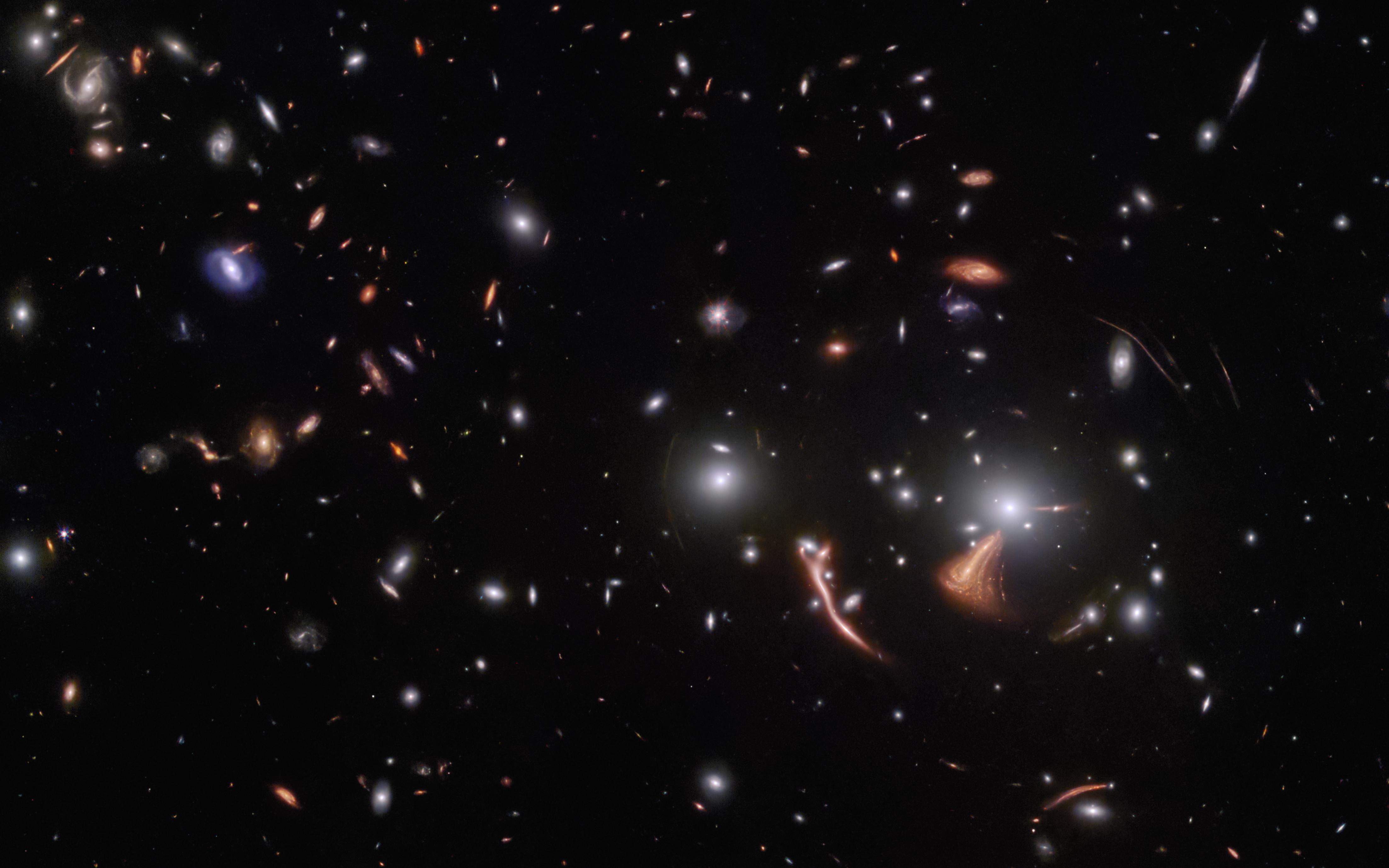
James Webb Space Telescope NIRCam
"If this structure is as real and as dense as the observations suggest, it forces us to re-examine the physics of the infant Universe."
What Webb Saw — and why it matters
The discovery begins with Webb's unparalleled sensitivity in the near- and mid-infrared. Using instruments optimized to detect redshifted starlight from the first billion years of cosmic history, teams have identified a string of luminous, dusty galaxies clustered along an extended region of sky. Spectroscopic redshifts place many of these galaxies at similar epochs — implying a three-dimensional association rather than a mere chance alignment on the sky. Mapping the stellar mass, star-formation rates, and inferred dark matter halos suggests that this is not a loose group: it is an enormous, coherent structure with a mass and extent comparable to the largest systems we see in the more recent Universe.
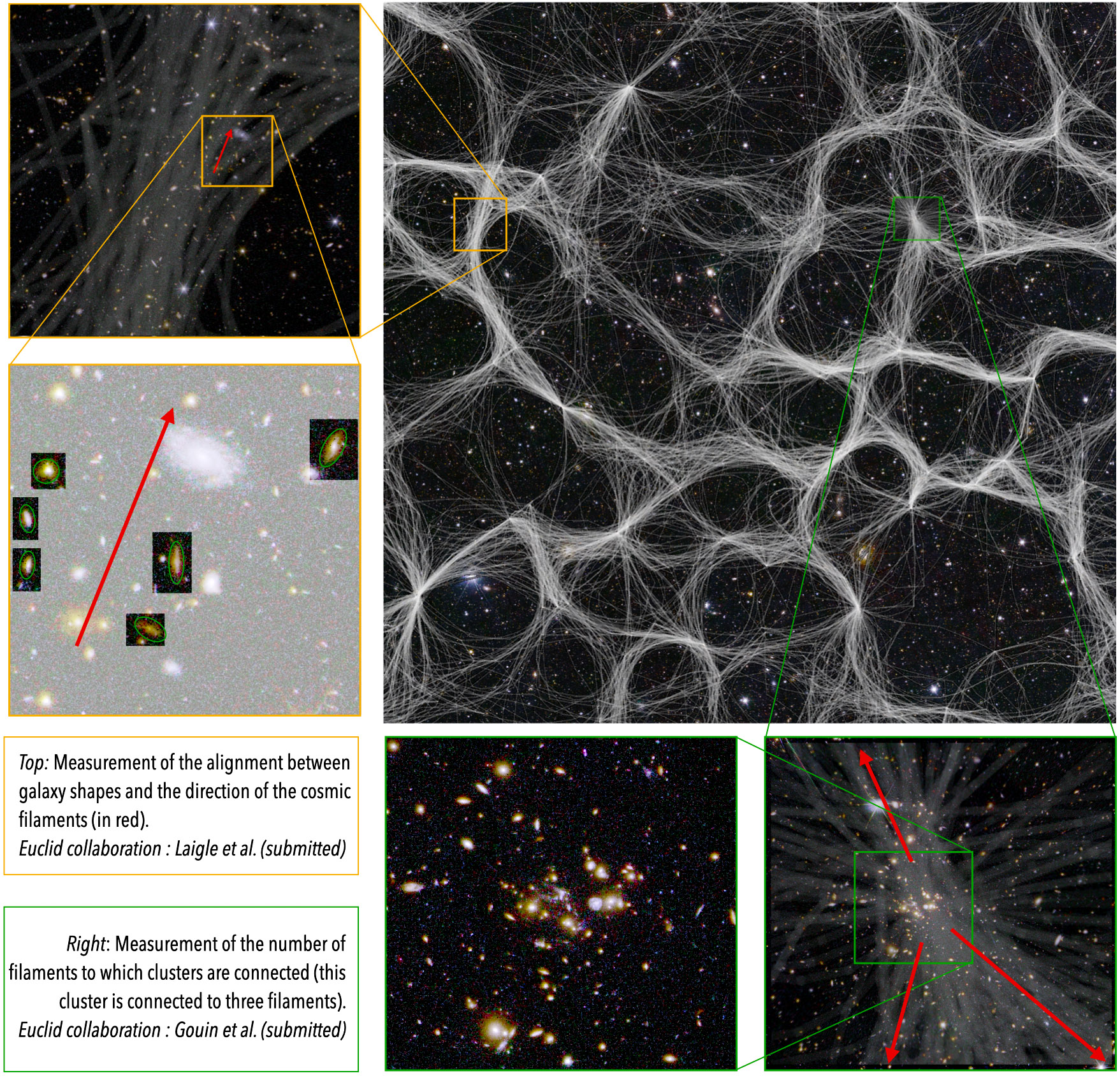
cosmic web galaxy filament
How these structures are measured
Detecting a large-scale structure is an exercise in layering observations:
- Imaging: Deep-field infrared imaging finds candidate galaxies by their brightness and color, especially the characteristic breaks produced by hydrogen absorption at known redshifts.
- Spectroscopy: Instruments measure emission and absorption lines to determine precise redshifts, converting angular positions into true distances.
- Mass estimates: Stellar mass comes from spectral energy distribution modeling, while total mass (including dark matter) is inferred from dynamics or gravitational lensing when possible.
- Spatial mapping: Combining the positions and redshifts yields a three-dimensional map, where statistically significant overdensities indicate genuine structures rather than random clustering.
Webb's combination of exquisite imaging and sensitive spectroscopy has compressed these steps into a single, powerful observatory capable of revealing the cosmic web at unprecedented epochs.
Why the structure is unexpected
The standard cosmological framework — the Lambda-Cold Dark Matter (Lambda-CDM) model — successfully explains a vast range of observations. In that model, tiny matter density fluctuations seeded by inflation grow over time via gravity. Cold dark matter aggregates first, creating potential wells where gas falls in and forms stars, leading to the hierarchical assembly of galaxies, groups, and clusters. The time available after recombination and the rate of growth encoded in Lambda-CDM predict characteristic scales and abundances of massive structures at each cosmic epoch.
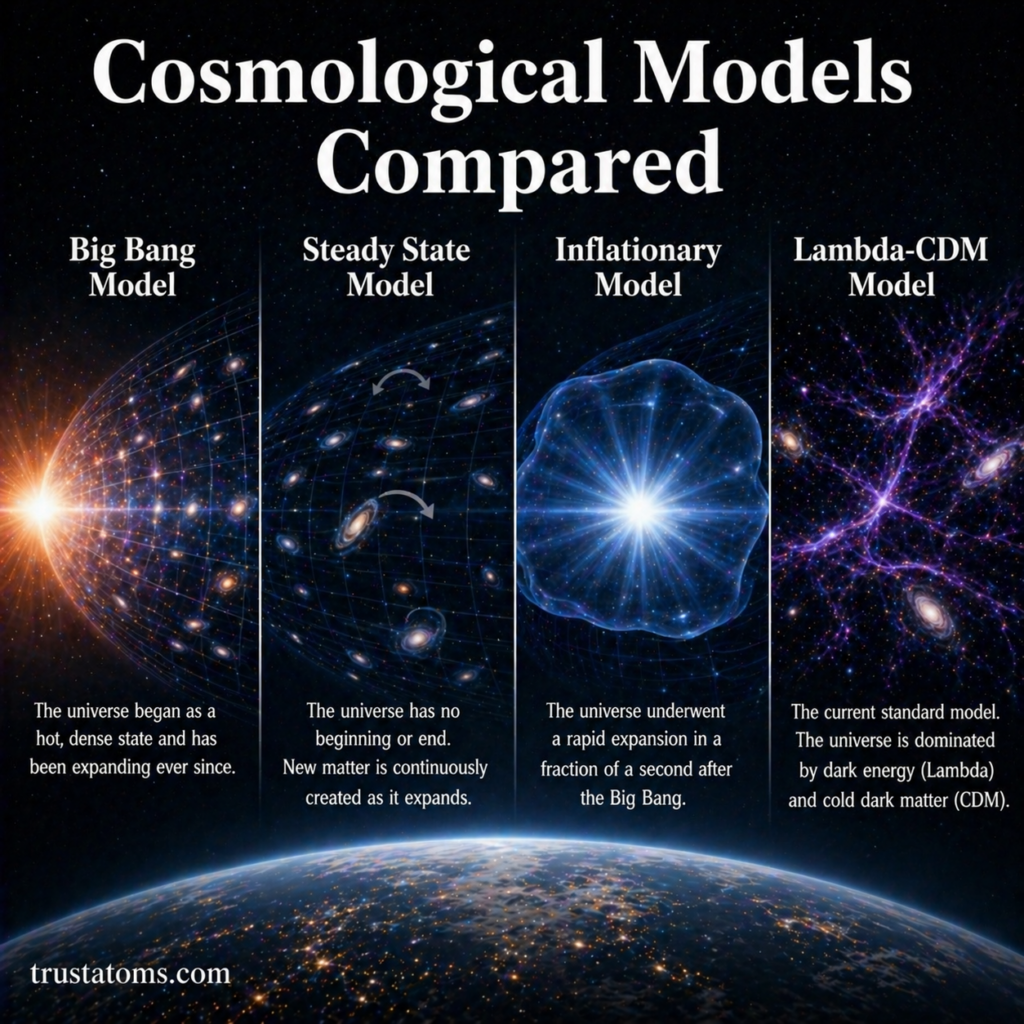
Lambda-CDM cosmological model diagram
This newly observed assembly appears both massive and coherent on scales that seem improbable so early. Three aspects make it especially surprising:
- Scale: The physical length and volume of the overdensity approach sizes normally associated with later-time superclusters.
- Mass: The inferred total mass — baryonic plus dark — appears very large given the cosmic age at the measured redshift.
- Coherence: The galaxies are not isolated massive outliers but part of an elongated, ordered filamentary arrangement, suggesting a mature network rather than nascent scatterings.
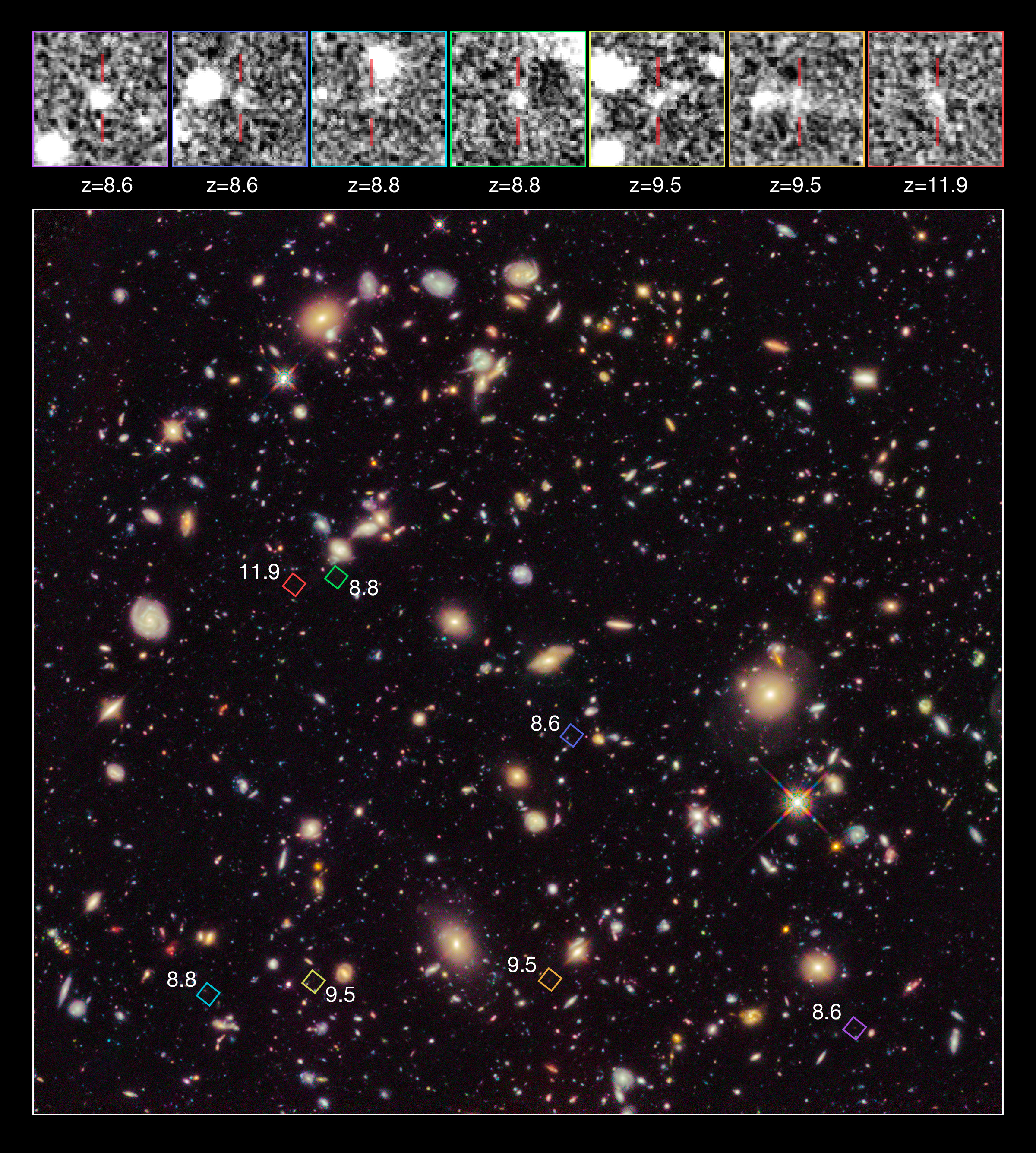
high redshift galaxy cluster
Those features together raise a simple question: can gravity assemble such a structure so quickly, or is some ingredient missing from current models?
Possible explanations — from mundane to radical
Scientists naturally proceed from conservative explanations toward more exotic ones. The most likely categories include observational bias, statistical fluke, or gaps in modeling; if these fail, the result could point to new physics.
1. Projection and selection effects
Even when spectroscopy is available, cosmic distances projected onto our two-dimensional view can conspire to make physically separate structures appear connected. Survey selection can favor bright, dusty galaxies that are easier for Webb to find, creating an apparent filament. Careful statistical tests, larger-area mapping, and independent observations will help reveal whether this is a line-of-sight illusion or a genuine physical structure.
2. Cosmic variance and rare objects
We live in a Universe with inherent randomness. Some regions are naturally denser than average. Cosmological simulations generate rare, extreme peaks in the density field — regions whose existence does not violate Lambda-CDM but are statistically unlikely. The question is whether the observed structure fits within the predicted tail of the distribution or sits outside the envelope of plausibility.
3. Underestimated baryonic physics
Our models of star formation, feedback from supernovae and black holes, and gas cooling are imperfect. If early galaxies formed stars more efficiently, or feedback was less suppressive than assumed, visible structures could appear earlier. That would require recalibrating sub-grid physics in simulations rather than overturning the overall cosmological model.
4. New dark matter properties
Cold dark matter is the default assumption, but variants — warm, interacting, or self-interacting dark matter — change how quickly small fluctuations grow and how halos merge. Some alternative dark matter models could enhance early structure formation on the scales observed. If repeated observations favor such models, particle physics would gain direct guidance from cosmic structure.
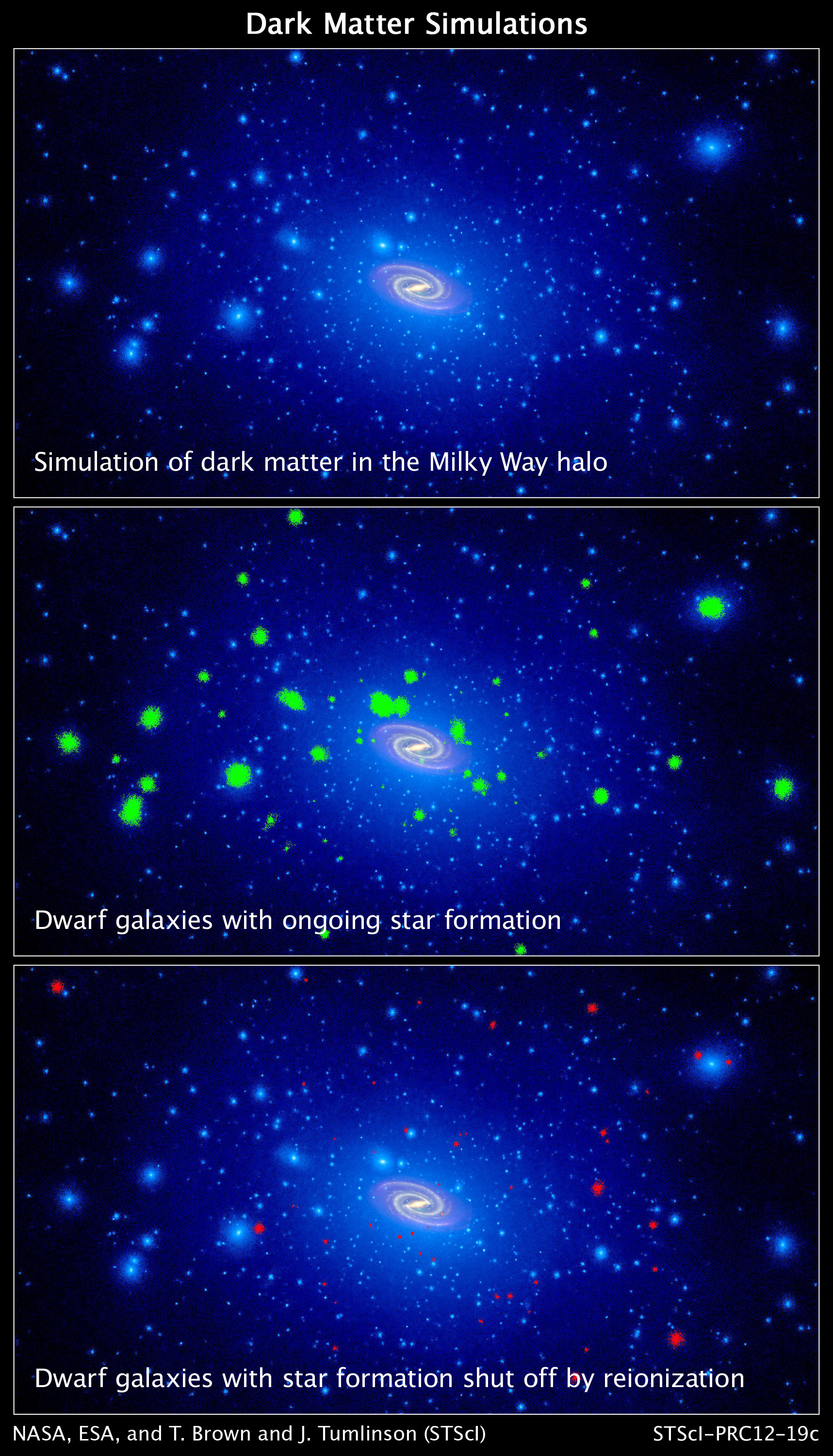
dark matter halo simulation
5. Early non-standard inflationary features or primordial fluctuations
Inflation set the initial spectrum of fluctuations. Deviations from the simple, nearly scale-invariant spectrum (for instance, extra power on specific scales or rare, large-amplitude fluctuations) could produce unexpectedly early, large structures. Detecting such deviations would open a window onto inflationary physics and the microphysics of the very early Universe.
What scientists will do next
Extraordinary claims require extraordinary evidence. The path from an intriguing Webb detection to a robust scientific revolution involves multiple, careful steps:
- Replicate the finding: Observe adjacent fields to establish spatial continuity and rule out chance alignment. Multiple instruments and facilities can provide independent verification.
- Deep spectroscopy: Secure higher signal-to-noise spectra for more member galaxies to refine redshifts and velocity dispersions, which improve mass estimates.
- Multiwavelength follow-up: Use radio, submillimeter, and X-ray observations to detect hot gas (a sign of mature clusters) and measure star-formation obscured by dust.
- Lensing analyses: Search for gravitational lensing signatures to measure total mass directly without relying on baryonic tracers.
- Simulations: Run targeted cosmological simulations that sample the extreme tail of initial conditions and explore alternative dark matter or baryonic physics.
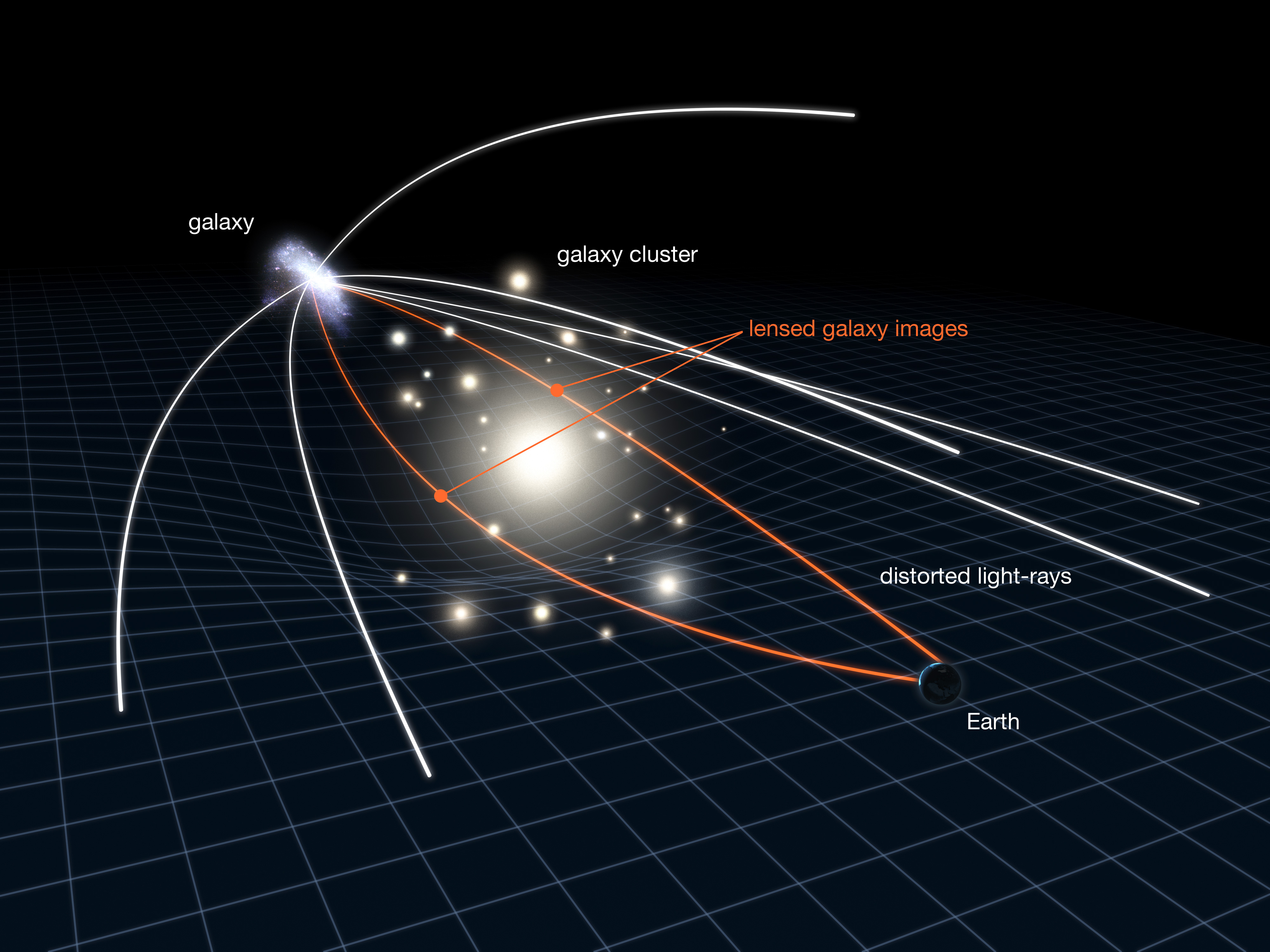
gravitational lensing cosmic structure
These coordinated efforts will clarify whether we have indeed discovered a new class of early cosmic giants or a compelling observational artifact.
What it would mean for cosmology if confirmed
Confirmation of a massive, coherent structure at high redshift would ripple through cosmology and astrophysics. Potential implications include:
- Revised formation timelines: Galaxy formation models might need to shift toward faster assembly in certain environments, altering our understanding of when the first big systems emerged.
- Constraints on dark matter: The nature and behavior of dark matter would gain new observational constraints, guiding particle physics theories.
- Inflationary insights: If primordial fluctuation spectra need adjustment, inflationary models would face new tests that reach back to the Universe’s first fractions of a second.
- Reassessment of cosmic homogeneity: The Cosmological Principle — the idea that the Universe is homogeneous and isotropic at large scales — could be tested in new ways. A truly anomalous structure might indicate previously unappreciated large-scale variation.
These are profound consequences, but science advances by confronting tension between observation and theory. Each tension becomes an opportunity: to refine models, to discover new physics, and to sharpen our picture of cosmic history.
A cautious conclusion — the science of skepticism
Large telescopes routinely reveal surprises, but the history of astronomy is littered with apparent anomalies that faded under scrutiny. Confirmation bias, selection effects, and the human appetite for exciting narratives can lead observers and the public to prematurely embrace revolutionary interpretations. That said, it would be equally unscientific to dismiss Webb's observation without rigorous examination. The correct scientific posture balances skepticism with openness: verify, quantify, and test competing models.
"Tension between data and model is where discovery often begins — but not every tension leads to a new law of physics."
Broader context — why this excites the public and scientists alike
At stake is more than a technical adjustment to simulations. The narrative of cosmic origins — how simple fluctuations grew into stars, galaxies, and the filigreed cosmic web — is central to our scientific and cultural story. Each time a new telescope extends our reach, we test that story. The James Webb telescope was built to push those boundaries, and the potential discovery of an oversized early structure is exactly the kind of result that tests the limits of our understanding.
For scientists, the discovery is data: a new input that constrains models. For the public, it rekindles awe: the Universe is stranger and more dynamic than everyday intuition suggests. Either way, Webb's finding promises to accelerate research, inspire new theoretical work, and motivate future observations from both space- and ground-based observatories.
Key takeaways
- Webb has identified an enormous, coherent concentration of galaxies at high redshift that appears larger and more massive than expected.
- Possible explanations range from observational projection and cosmic variance to revisions of baryonic physics or dark matter properties.
- Confirming the structure will require multiwavelength follow-up, more spectroscopy, lensing studies, and targeted simulations.
- If validated, the finding could reshape models of early structure formation and provide new constraints on dark matter and inflation.
Final reflection
The beauty of observational cosmology is that the Universe keeps issuing invitations to rethink our assumptions. Whether this massive Webb-detected structure becomes a textbook-changing discovery or a resolved anomaly, the process will tighten the links between observation, theory, and simulation. The next few years of observations and analysis will tell us whether the early Universe was more rapidly productive than we thought — or whether our instruments simply caught a rare, beautiful quirk of cosmic geography. Either outcome advances knowledge: by sharpening our models or expanding them to accommodate a deeper, stranger cosmos.