Indonesia Volcano Emits Icy Violet Lava at Night — The Science
On a moonless night in eastern Java, a rim of otherworldly light can appear to run and spill across a volcanic flank: a pale, icy violet glow that looks for all the world like lava painted in ultraviolet. Videos and photographs that circulate online make the scene look impossible — molten rock in a shade you usually only see in science fiction. But what you are really seeing at places like Kawah Ijen is both real and explainable: a glowing chemical fire, shaped by chemistry, optics, and the tools we use to look into the dark. This article unpacks the phenomenon, explains why observers describe it as violet, and gives practical context for safety, science, and tourism.
Kawah Ijen crater Java
THE VOLCANO AND THE NIGHTLIGHT
Where it happens — the crater and its ghosts
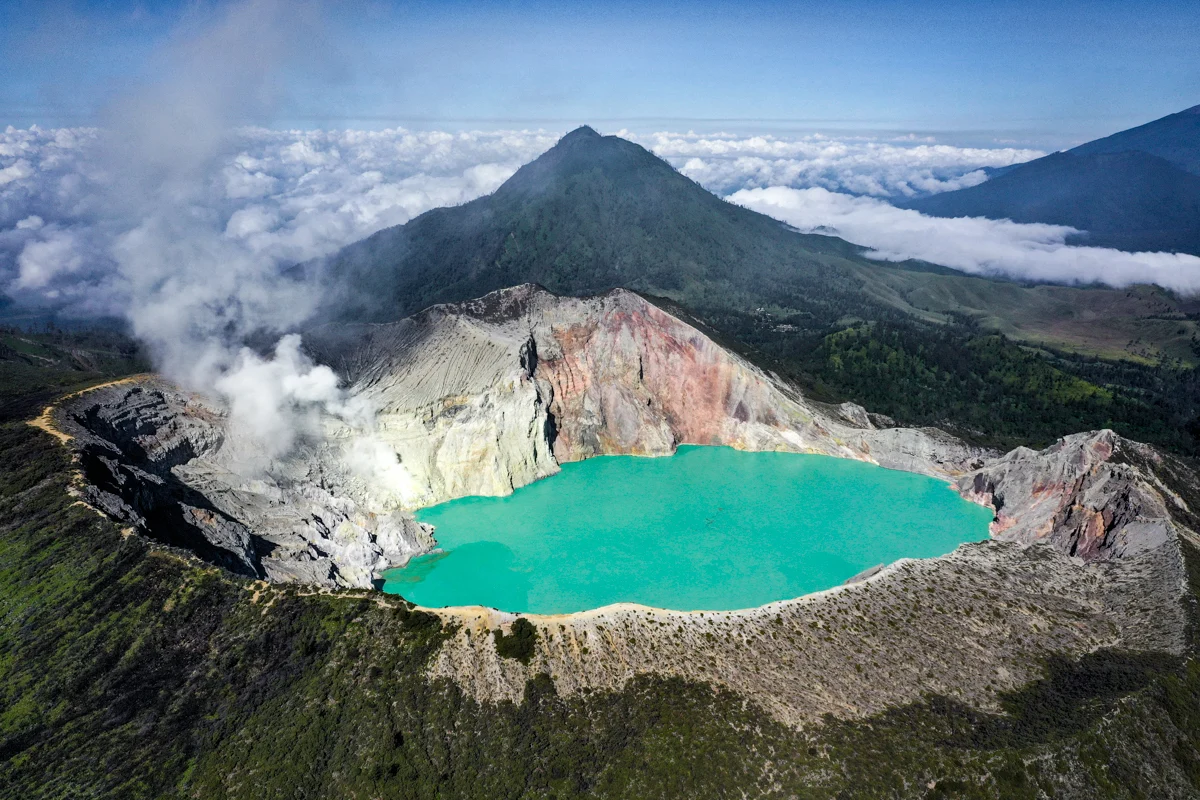
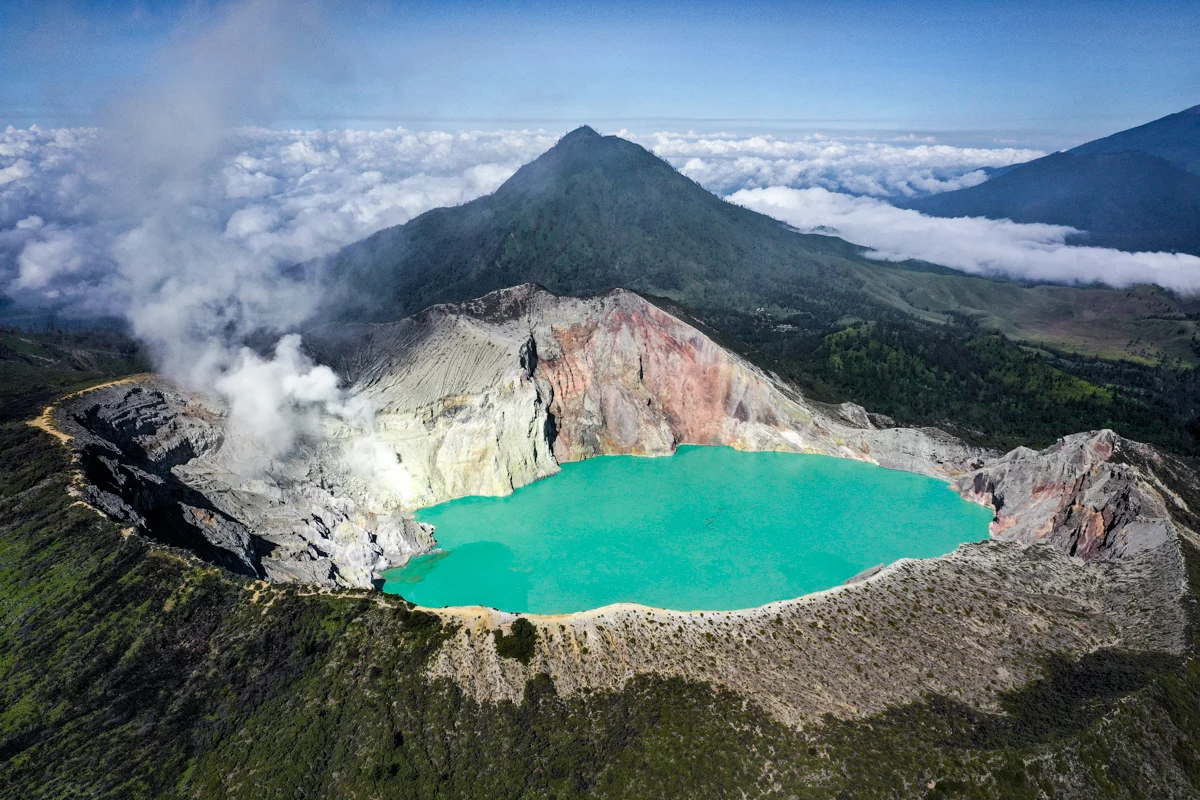
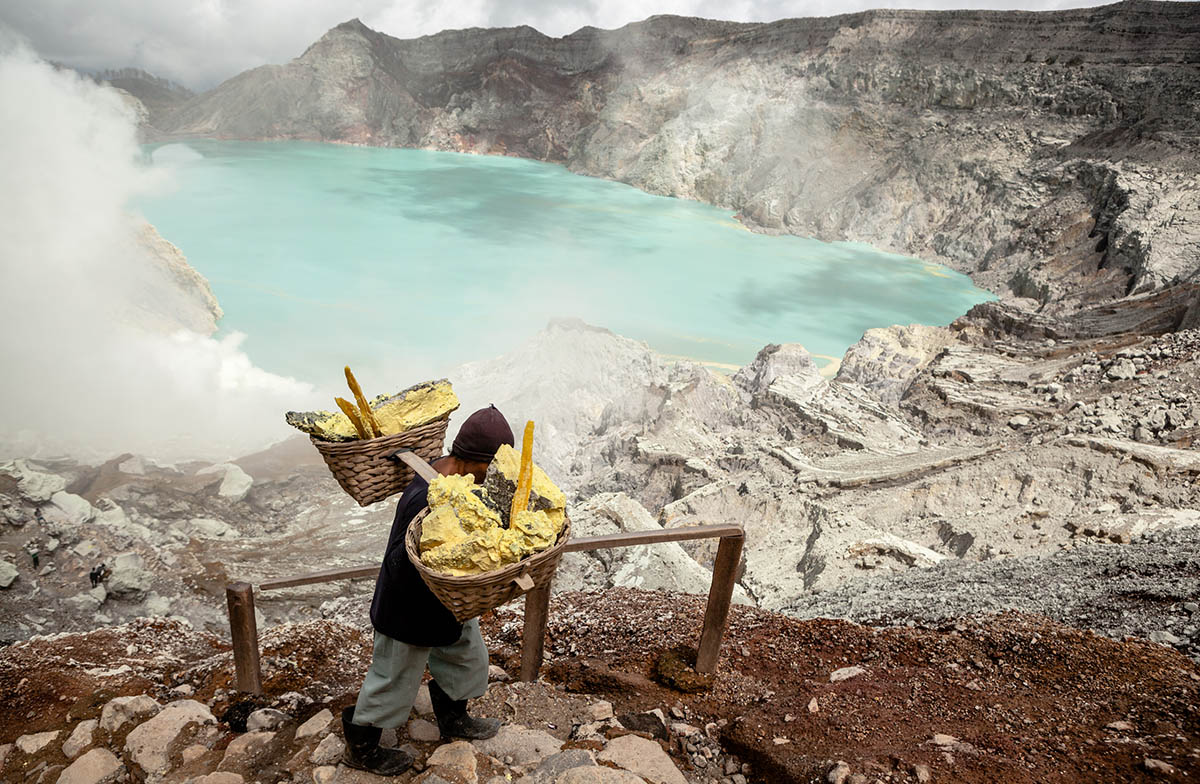
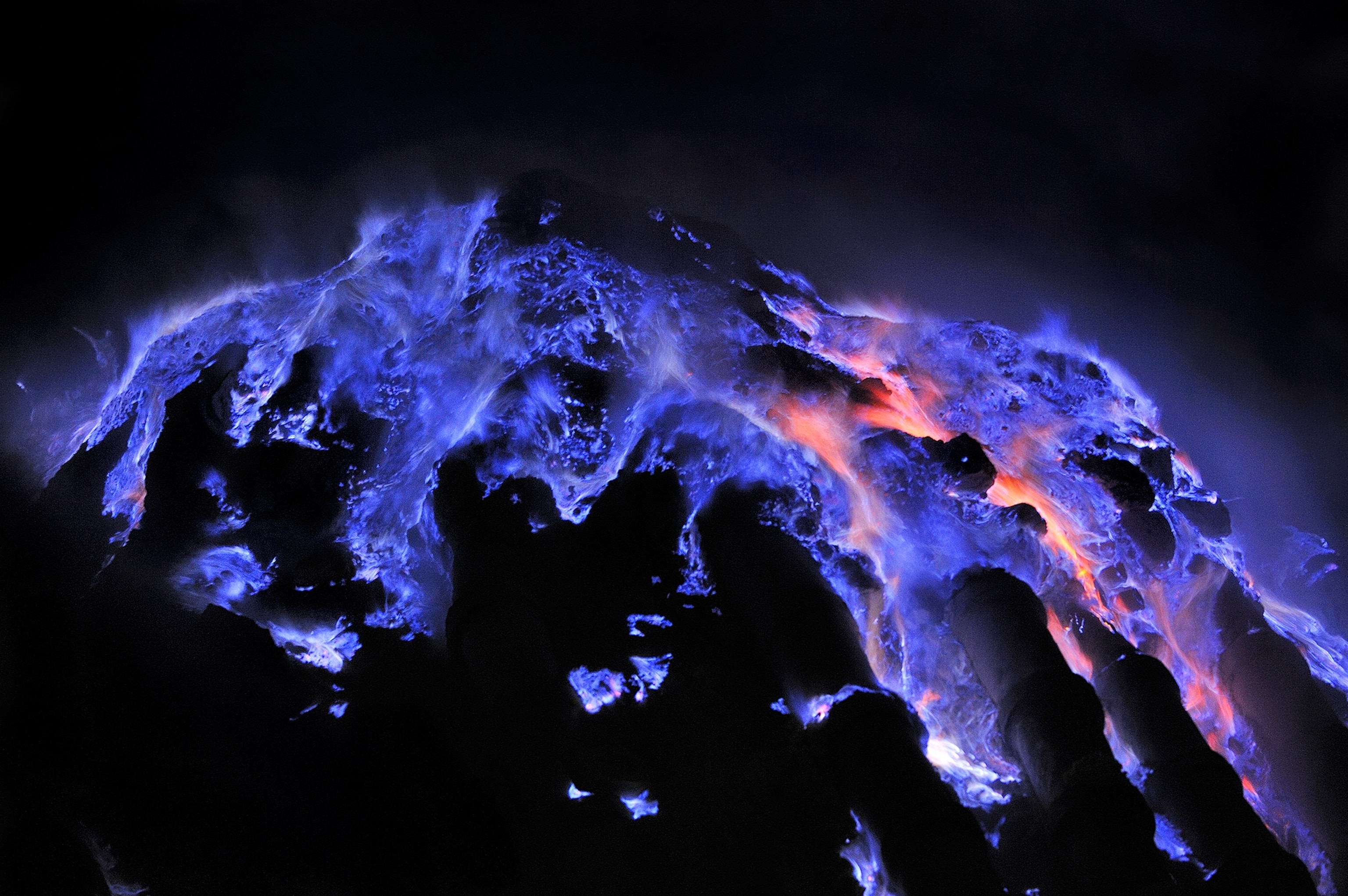
Kawah Ijen, a stratovolcanic complex on the island of Java, Indonesia, is world-famous among photographers and geologists for one of the planet’s rare nighttime spectacles. Above an acid crater lake sits a sprawling deposit of native sulfur; vents and fissures bathe that sulfur in superheated gases. When sulfur vapors ignite as they escape and flow, they produce an intense blue flame, visible best after dark. Local miners, who have worked these deposits for generations, extract sulfur that condenses along the crater walls into bright yellow crystals during the day and becomes part of the dramatic nightscape when gases fire.
Sulfur mining Kawah Ijen
Not lava — a crucial distinction
That violet or blue glow is not molten basalt or andesite. Typical silicate lava is red, orange, or white-hot depending on temperature. The unusual hues at Kawah Ijen are a product of chemical combustion — burning sulfur and volatile gases — not the eruption of magmatic lava above the surface. Calling it "violet lava" is therefore a poetic shorthand, not a geological description. Part of this article’s goal is to untangle the poetic from the physical so viewers can appreciate the wonder without mistaking the mechanism.
Blue flame sulfur combustion
WHY THE COLOR LOOKS VIOLET OR 'ICY' AT NIGHT
The chemistry: sulfur and flame color
Elemental sulfur burns with a characteristic blue flame. When sulfur vapor ignites, the excited molecules emit light in a narrow range of wavelengths that our eyes perceive toward the blue end of the spectrum. The exact color depends on the combustion temperature, the presence of other gases (like sulfur dioxide, SO2), and particulate matter. In clean, pure combustion under ideal viewing conditions the flame often looks deep blue; in variable conditions it can tip toward indigo, cyan, or even violet.
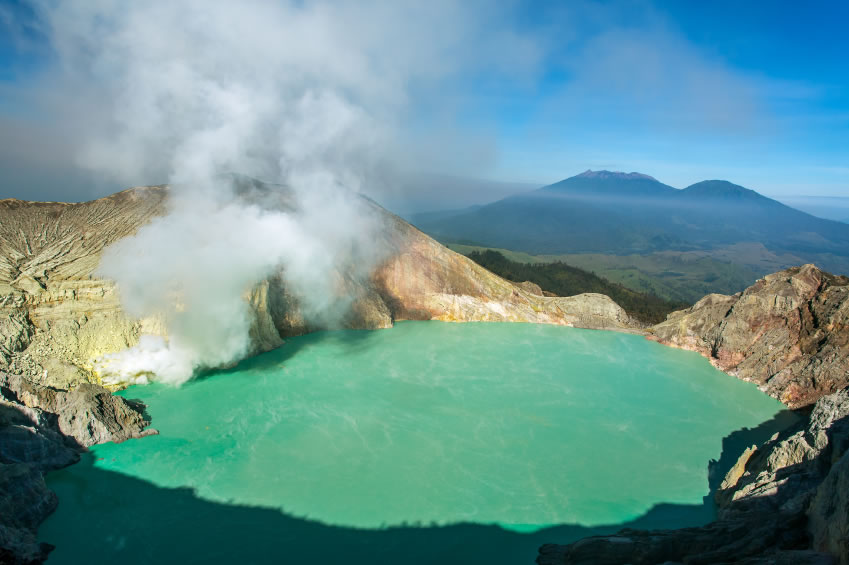
Kawah Ijen acid lake
Optics, scattering, and perception
Human perception is not fixed: a small shift in the distribution of emitted wavelengths, and the way our cones interpret them against a black background, can produce a vivid impression of violet or icy blue. Atmospheric scattering plays a role too: tiny droplets of acid, suspended ash, or fine aerosolized minerals from sulfur condensation can scatter shorter wavelengths differently than longer ones, nudging the perceived color toward the violet end of the spectrum. Nighttime conditions also lower the surrounding luminance, which heightens color contrast and makes weak blue-violet emissions look more saturated.
Cameras and long exposures: the reason footage often looks surreal
Modern cameras amplify what our eyes see. Long exposure photography, higher ISO settings, and white-balance choices can accentuate blue and violet tones. Sensors have different sensitivity curves across red, green, and blue channels; when blue light dominates, sensors can report an image that reads as more vibrantly violet than your eye remembers. Photographers also often boost saturation in post-processing for dramatic effect. That combination — a real blue flame plus camera amplification — explains many viral clips showing "icy violet lava."
The glowing fringe is real; the label "violet lava" is a mix of chemistry, optics, and camera tricks.
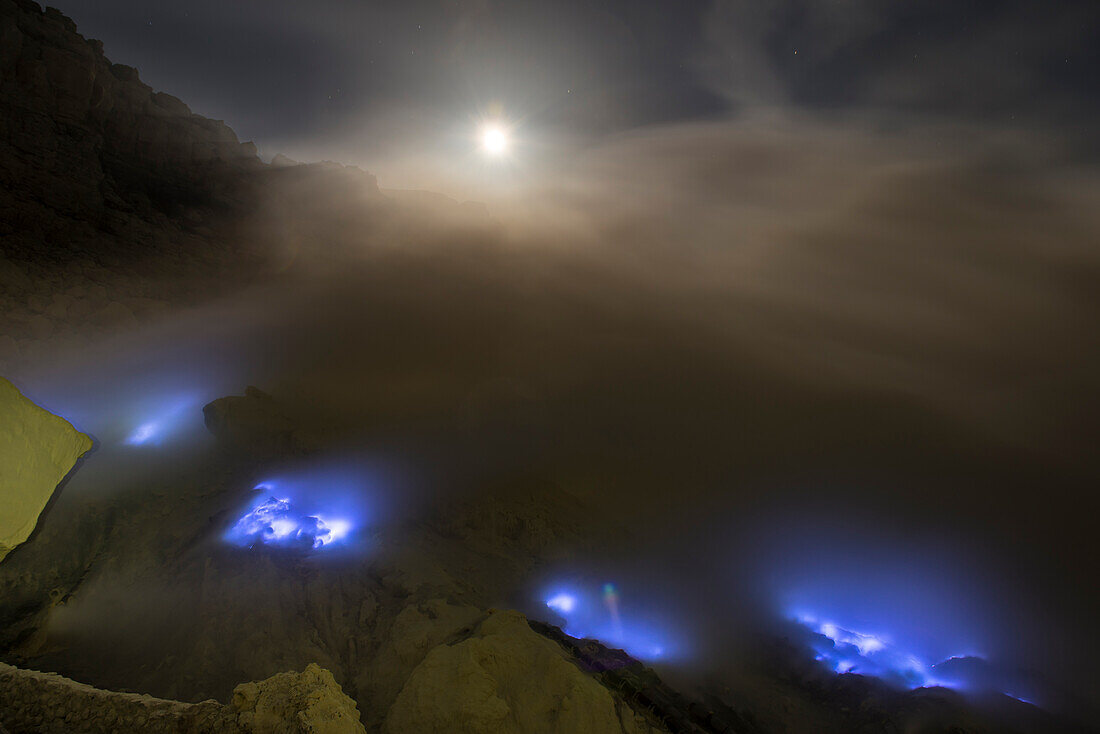
Ijen crater night photography
THE SCIENCE BEHIND THE FLAME
Sulfur's physical properties
Sulfur undergoes a sequence of phase changes as it heats: it melts to a viscous liquid, then vaporizes and can ignite in air. Burning sulfur produces sulfur dioxide and other sulfur oxides, releasing energy and emitting light. While elemental sulfur's combustion spectrum contains strong blue components, mixes of sulfur with small amounts of other volatiles (hydrogen sulfide, trace metals, or organic compounds) can introduce additional emission lines that shift hue subtly. Geologists and chemists who have investigated these vents find a dynamic micro-environment where chemical and thermal gradients determine exactly what color burns.
Temperature context
By comparison, molten lava is hot enough to radiate black-body thermal light in the red-to-white range: basaltic lava is roughly 1,000–1,200°C, and even cooler lavas still glow orange-red. Sulfur combustion occurs at lower temperatures than typical molten rock combustion and produces emission spectra rather than black-body radiation. That is a technical way of saying: different processes produce different kinds of light, and the color tells you what process is happening.
SAFETY, ETHICS, AND THE HUMAN COST
Toxic gases and dangerous terrain
Beautiful though the lights are, the crater environment is hazardous. Sulfur dioxide and other volcanic gases are extremely irritating and can be lethal at high concentrations. The lake at Kawah Ijen is highly acidic, and the crater rim is steep and unstable in places. Local miners work in this landscape every day, hauling heavy loads of sulfur on paths that pass through noxious fumes. Anyone planning to visit must recognize that close proximity to vents can be dangerous without proper protection and permits.
Tourism impacts and local livelihoods
Photographers and tourists can bring income to remote volcanic communities but also strain fragile environments and disturb laborers who work the sulfur fields. Ethical visiting means supporting licensed guides, respecting local regulations, and understanding the human dimension: the luminous crater is part of a landscape that people depend on — often at great personal risk.
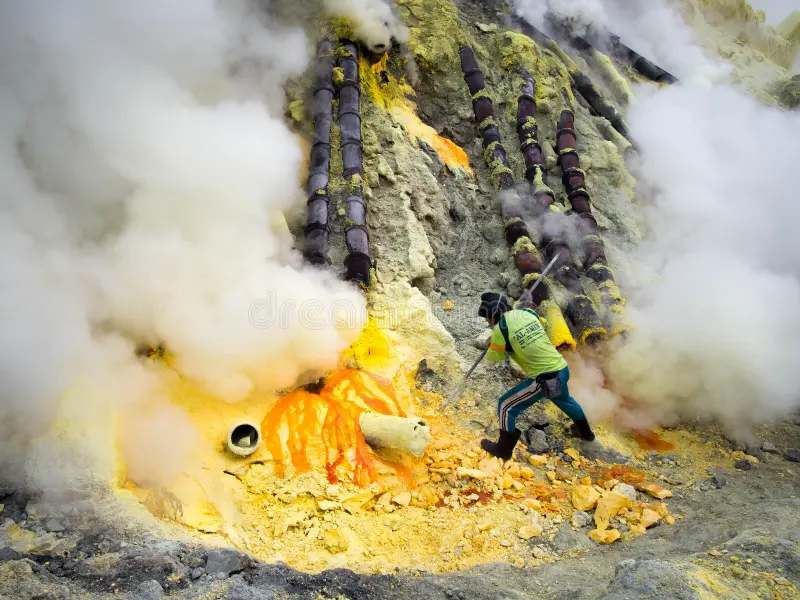
Sulfur miners Indonesia
HOW SCIENTISTS STUDY THE PHENOMENON
Field measurements and lab spectroscopy
Researchers study sulfurous flames using portable spectrometers to capture emission lines, and thermal imagers to map temperature gradients. Gas sampling quantifies SO2, H2S, and other components. Laboratory combustion experiments reproduce vent chemistry to understand how mixtures and particulate loads shift observed colors. Combining in-situ measurements with remote sensing helps scientists separate optical effects from chemical signatures.
Why it matters beyond the spectacular
Volcanic gas chemistry offers clues about subsurface processes and can be an early indicator of changing volcanic activity. Sulfur flux, gas composition, and vent temperatures are pieces of the puzzle that volcanologists use to monitor a crater's health. Moreover, understanding combustion at sulfur-rich vents informs industrial safety and the study of similar chemical processes on other planetary bodies.
PHOTOGRAPHY TIPS: CAPTURING THE GLOW WITHOUT DISTORTION
Practical camera settings and choices
To photograph the blue-violet glow faithfully, start with a tripod and low ISO to preserve detail, then experiment with exposures. Shorter exposures tend to show a truer representation of what the eye sees; long exposures amplify sensor sensitivity and may shift hues. Shoot RAW if possible and use white-balance adjustments conservatively. Bracketing exposures and comparing on-site will help you avoid unintentionally inventing colors in post.
Ethical composition
Include context: show miners at work (with consent), the rim, and the crater lake. Giving viewers scale and human context makes the images more meaningful and reduces the tendency to exoticize a dangerous workplace.
COMMON MISCONCEPTIONS
"It's actual purple lava"
As emphasized earlier, the phenomenon is not magmatic lava colored purple. It is combustion of sulfurous gases; the use of "lava" is metaphorical and can mislead people about the actual hazards and processes involved.
"The color is fake or digitally added"
Some images are certainly enhanced, but many are genuine captures of sulfur flames whose hue is shifted naturally by the physics of emission and by camera/sensor responses. The truth often lies between sensationalism and dismissal.
PRACTICAL ADVICE FOR VISITORS
When to go and how to prepare
If you plan to see the glow, going after full dusk and before sunrise yields the longest period of darkness for viewing. Dress for cold wind at altitude, bring a gas mask or at least an effective respirator, and hire a licensed guide. Respect all closed signs; guided viewpoints maintain safe distances from unstable edges and concentrated gas plumes.
Respectful behavior
Follow leave-no-trace principles, avoid disturbing miners during their work, and consider supporting local cooperatives or vendors rather than taking photos that exploit labor conditions without benefit to the community.
Beautiful but dangerous: treat the crater like a living laboratory, not a stage for stunts.
CONCLUSION — WHY THE SPECTACLE MATTERS
The icy violet lights on the flanks of an Indonesian crater are a reminder of how chemistry and optics can collaborate to produce spectacle in nature. They show the planet's capacity to surprise us with colors outside everyday expectations — while also revealing the fragile human stories and real hazards that lie behind every viral image. Appreciating the phenomenon fully means understanding what it is (burning sulfur and glowing gases), what it is not (magmatic purple lava), and how to witness it responsibly.
- Color origin: The blue–violet glow is combustion of sulfur and escaping gases, not molten lava.
- Perception factors: Atmospheric scattering, human vision, and camera settings can shift hues toward violet.
- Risk: Toxic gases and unstable terrain make safe, guided observation essential.
- Respect: Visit ethically, support local guides, and remember the miners who work in hazardous conditions.
Photographs and firsthand accounts capture a phenomenon that blends chemistry with optics; the glow is real, but its explanation is richer than a single color.